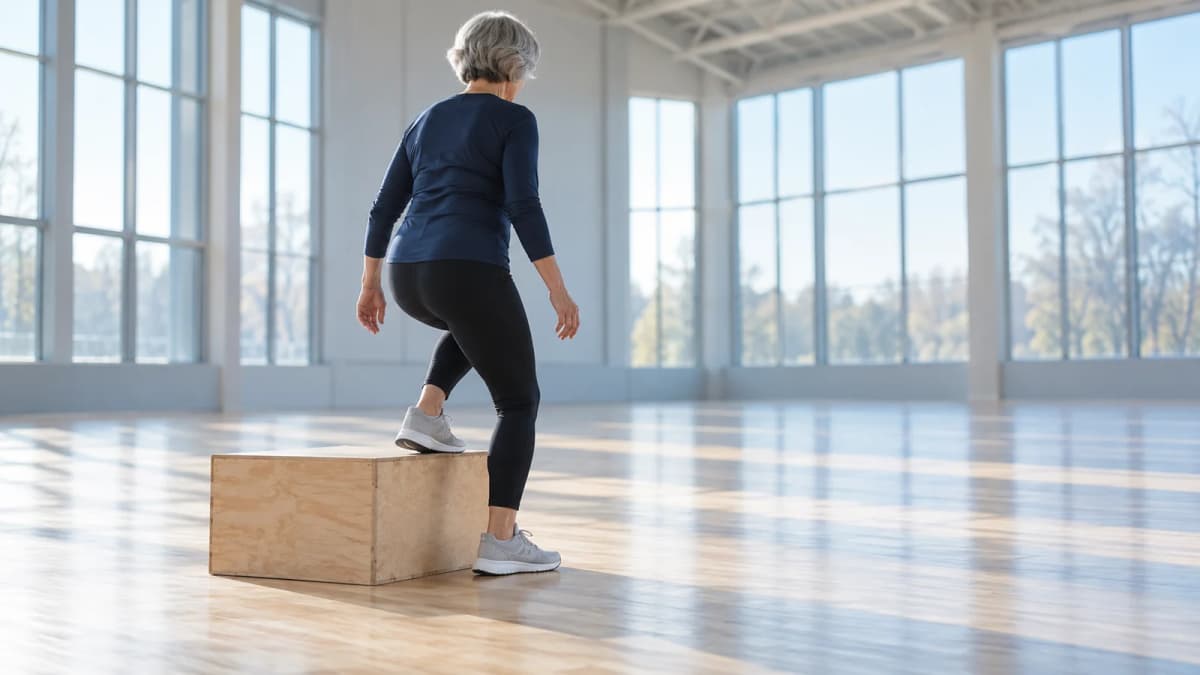
What a new mouse experiment suggests about why exercise that loads the skeleton may matter for ageing beyond bone strength, and where the human evidence currently stops.
On 23 October 2026 the journal Cell Metabolism published a study from Southern Medical University in Guangzhou and research centres in Kunming, China. The team took mice that were already 20 months old, which is old by mouse standards, and assigned them at random to two groups. In one group a device applied repeated compression along both shin bones (the tibiae) for four months, until the animals were 24 months old. The other group received no loading. Males and females were included.
The loaded mice lived longer. Median lifespan rose by 9.4% on average, or about 79.5 days. Mean lifespan was 11.9% longer in females and 7.7% longer in males; maximum lifespan was 7.6% and 15.4% longer, respectively. At 24 months the loaded animals also did better on tests of memory (a water maze) and of balance and coordination (a rotating rod, a hanging wire and a vertical pole), handled glucose and insulin better and had more bone. Markers of cellular senescence and inflammation were lower in several organs.
Can bone sense force beyond the skeleton?
The study started from a simple question: what happens to the body when bone stops sensing force? Bone cells called osteocytes register mechanical load through an ion channel called Piezo1. When the researchers switched this channel off in the osteocytes of middle-aged mice, from 10 months of age, the animals aged faster as a whole: memory and motor performance declined, senescent cells accumulated in many organs, and median survival was 13.2% shorter in males and 10.7% shorter in females.
Loading appeared to act partly through the bone marrow, where immune cells are made. In old mice the marrow shifts towards myeloid cells and away from T and B lymphocytes, a pattern known as immunosenescence. After four months of loading, this shift was partly reversed.
The team also identified a protein that bone releases in response to load: pigment epithelium-derived factor, or PEDF. In loaded mice its blood level rose from 1.856 to 11.93 ng/mL. When old mice were given PEDF by injection for two months, senescence markers fell and memory and coordination improved. Whether PEDF on its own extends survival was not tested.
What does this study still not show?
Every lifespan result here comes from mice. The survival figure reports 60 animals without a clear breakdown by sex and group, and the article text gives no exact p-values for the survival curves. The control mice did not go through a sham procedure, so the effect of loading cannot be fully separated from the handling that came with it. The paper describes the loading protocol inconsistently. The loading itself was a laboratory technique, with a machine compressing a bone, not a form of exercise.
The human part is thin. Blood PEDF was lower in people aged 60–80 than in those aged 20–40, and lower still in older adults with osteoporosis; genetic analyses using Mendelian randomisation pointed in the same direction. These are associations, not intervention results; the paper does not state the plasma sample size. This paper describes no human trial of bone loading or PEDF against ageing. The work was funded by the National Natural Science Foundation of China and Chinese provincial programmes, and the authors declare no competing interests.
What has actually been tested in people?
The human evidence cited here concerns bone itself, not ageing. In the Australian LIFTMOR trial, 101 postmenopausal women with low bone mass were randomised to eight months of supervised high-intensity resistance and impact training or to a home-based low-intensity programme. The supervised group gained bone density in the lumbar spine and at the femoral neck and improved on every functional test, with one minor adverse event reported. That trial was not designed to say anything about lifespan.
So the new paper does not show that jumping or lifting weights extends human life. What it adds is a mechanism worth following: the skeleton may take an active part in the ageing of the whole body, sending signals that mechanical load switches on. The authors suggest this could one day help people who cannot exercise; for now that is a hypothesis for future trials.
If you are considering adding impact or heavy strength training, especially with osteoporosis, a past fracture or joint problems, discuss with your doctor how to start safely.
This article is for information only and does not replace a consultation with a doctor.
Sources
Zhang Z, et al. Dynamic force sensing by bone delays aging and extends lifespan. Cell Metabolism, 2026. PMID 42914985 · DOI 10.1016/j.cmet.2026.09.020
Watson SL, et al. High-intensity resistance and impact training improves bone mineral density and physical function in postmenopausal women with osteopenia and osteoporosis: the LIFTMOR randomized controlled trial. Journal of Bone and Mineral Research, 2018. PMID 28975661
What this piece relies on
Cards
- PublicationWatson SL, et al. High-Intensity Resistance and Impact Training Improves Bone Mineral Density and Physical Function in Postmenopausal Women With Osteopenia and Osteoporosis: The LIFTMOR Randomized Controlled Trial. J Bone Miner Res, 2018
- PublicationZhang Z, et al. Dynamic force sensing by bone delays aging and extends lifespan. Cell Metab, 2026
Articles in this section are educational and are not medical advice, a diagnosis, or a prescription. Consult a qualified professional before acting on anything you read here.
Read next
 ResearchMedicine and treatment
A nasal psychedelic, a blood pressure pill and VR before surgery: a roundup
4 stories this week: depression that resists treatment, high blood pressure with kidney disease, blood counts on a common class of diabetes and heart drugs, and anxiety before surgery, each with who it was tested on and what it does not yet show.
6 min readDigest · 4 stories
 ResearchMedicine and treatment
A post-dialysis injection lowered parathyroid hormone, and calcium too
For people on haemodialysis and their families: what lowering one blood hormone can tell about this treatment, and what it cannot yet tell about longer-term health.
5 min read ResearchBiomarkers
Step rhythm on a wristband nearly matched a walking test on death risk
If you wear a fitness tracker or have had your walking pace timed, here is what each number can and cannot tell you about long-term risk, and why the simple clinic test still keeps a small edge.
5 min read