CAR-T Beyond Cancer: What "Drug-Free Remission" Measured in Lupus, Myositis and Scleroderma
Cell therapies built for blood cancers have put a few dozen people with refractory lupus, myositis and systemic sclerosis into drug-free remission — in case series and phase 1 trials. How many exactly, which remission standard, how long the follow-up — and why none of it is a treatment option yet.
If you have lupus, myositis or systemic sclerosis, you have probably seen the headline: a cancer cell therapy "reset the immune system", and people came off all their drugs. The papers are real and the remissions are real — and the numbers behind them are smaller and shorter than the headline suggests. Here is what was measured, in how many people, and for how long.
One thing first, because it changes how everything below should be read: no cell therapy is approved anywhere for lupus, myositis or systemic sclerosis. CD19 CAR-T products and the T-cell engager teclistamab are marketed for B-cell cancers and multiple myeloma. Using them in autoimmune disease is investigational or off-label, and almost all of it has happened at a handful of specialist centres.
This is an informational article. It is not a diagnosis, not a treatment recommendation, and it does not replace a consultation with your doctor.
Why borrow a cancer therapy at all?
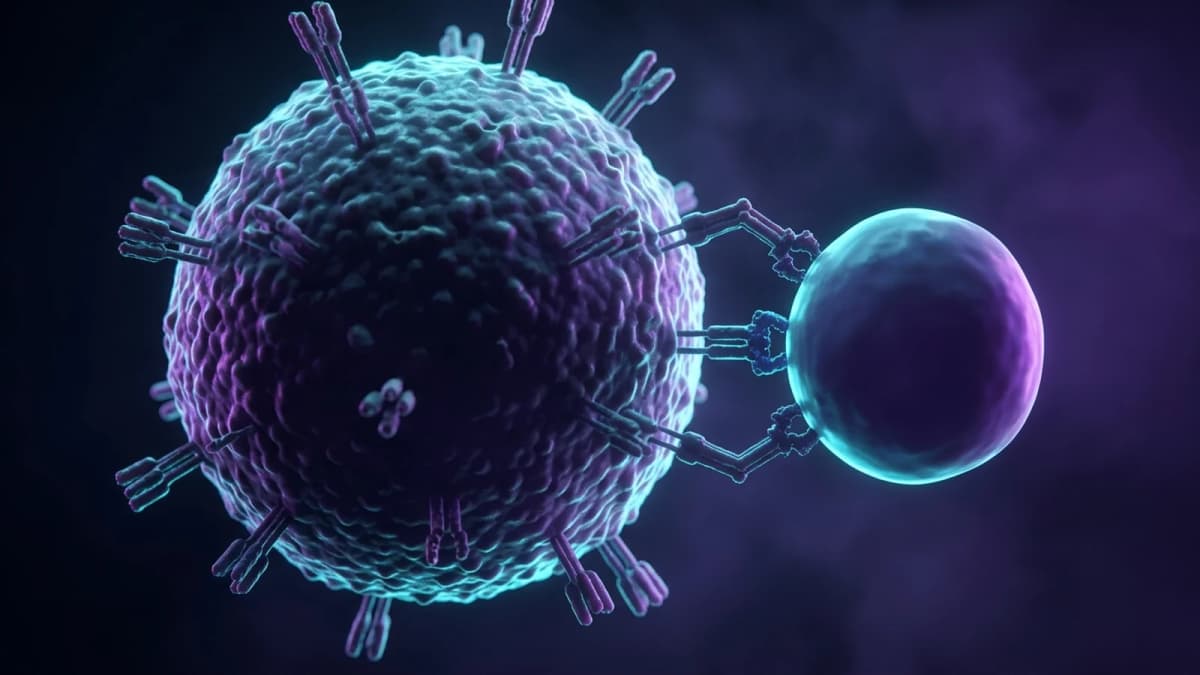
The rationale behind these studies is that these three diseases are driven in part by B cells and the plasma cells they become, and that existing drugs reduce B cells but rarely erase them. CAR-T means taking a person's own T cells, engineering them to recognise a marker on B cells (CD19) or plasma cells (BCMA), and infusing them back. The published idea is that if the B-cell compartment is emptied deeply enough and then regrows, the autoreactive part of it may not come back.
Two practical details get lost in the retelling. The infusion is preceded by lymphodepleting chemotherapy — fludarabine and cyclophosphamide — which suppresses the immune system on its own. And in these studies the patients' immunosuppressive drugs were stopped. In the first case series, B cells were absent for a mean of 112 ± 47 days before returning.
How many people, and what did "remission" actually mean?
One German centre, 15 patients (NEJM, 2024). Eight with systemic lupus erythematosus, three with idiopathic inflammatory myositis, four with systemic sclerosis; one infusion each. Median follow-up was 15 months (range 4–29). All eight lupus patients reached DORIS remission; all three myositis patients had an ACR-EULAR major clinical response; all four sclerosis patients had a lower EUSTAR activity index — a drop in an activity score, which is not the same sentence as remission. Safety: grade 1 cytokine-release syndrome in ten, one grade 2, one grade 1 neurotoxicity, and one pneumonia that needed hospital admission.
CASTLE, the first trial of a product made for this purpose (Nature Medicine, January 2026). A phase 1/2a basket trial of an autologous CD19 CAR-T, 24 people enrolled between July 2023 and January 2025: 10 lupus, 9 systemic sclerosis, 5 myositis. The primary endpoint was safety — the rate of cytokine-release syndrome and neurotoxicity. There was no cytokine-release syndrome above grade 2 and no neurotoxicity. At the 24-week secondary endpoints: 9 of 10 lupus patients reached DORIS remission; 9 of 9 sclerosis patients had no progression of interstitial lung disease; 4 of 5 myositis patients reached an ACR major or moderate response. In total 22 of 24 met the endpoint predefined for their own disease, and all 24 stayed off glucocorticoids and other immunosuppressants for the full 24 weeks. There was no placebo group and no comparison drug, and 24 weeks is the entire observation window in the paper.
Two targets at once, lupus only (Nature Medicine, September 2025). A phase 1 trial, still described as an ongoing dose escalation, co-infusing anti-CD19 and anti-BCMA CAR-T in 15 adults with refractory lupus. No dose-limiting toxicities. Median follow-up was 712 days — the longest among the studies cited here. 12 of 15 met both Lupus Low Disease Activity State and DORIS remission by week 12. Grade 1 cytokine-release syndrome occurred in 86.7%, with no neurotoxicity and no treatment-related deaths — but grade 3 or higher neutropenia occurred in every patient, thrombocytopenia in 40% and anaemia in 13.3%, all described as reversible with supportive care. The paper's phrase about a "potential cure" refers to three patients followed for a year for the disappearance of pathogenic B-cell clones. It is not a claim about the cohort.
Donor cells instead of your own. A Cell report (2024) described three patients — one necrotising myopathy, two diffuse cutaneous systemic sclerosis — with deep remission at six months and no cytokine-release syndrome. A phase 1 trial in Nature Medicine (2025) gave an allogeneic CD19-targeting product to five people with severe refractory lupus and lupus nephritis: all five met SRI-4 at month 3 and still at month 6, with one mild flare at month 6. SRI-4 is a four-point improvement on an activity index — a response, not the DORIS bar.
Not CAR-T at all. Teclistamab, a BCMA T-cell engager, has been used as rescue therapy: one lupus patient reported in NEJM in 2024 with drug-free complete remission after a short course — the paper does not state how long she was followed; then ten patients with various refractory autoimmune diseases in NEJM in October 2025, with clinical and serologic improvement in most — but the letter does not break down how many were in drug-free remission, or for how many months. Both are correspondence describing compassionate use — no control group, no prespecified primary endpoint. A separate six-patient BCMA CAR-T series exists only as a conference abstract, so its figures are not quoted here.
What do the remission words mean?
This is where most of the confusion lives, because each disease is measured on its own ruler and the rulers are not equally strict.
DORIS — Definition of Remission in SLE, a named lupus remission standard. The strictest bar used above.
LLDAS — Lupus Low Disease Activity State. Low activity, not remission.
SRI-4 — a four-point improvement on a lupus activity index. A response.
ACR-EULAR major or moderate response — a myositis improvement score, graded by degree.
EUSTAR index — a scleroderma activity score. "Lower EUSTAR" means less active disease.
"No progression of interstitial lung disease" — the scleroderma endpoint CASTLE actually set. It describes something that did not get worse over 24 weeks. It does not say the disease went away.
So "9 of 9 sclerosis patients met the endpoint" and "scleroderma was cured in 9 people" are different sentences, and only the first one is in the paper.
What none of this shows
There is no cure here, and nothing a rheumatologist can prescribe as standard care. The largest study with a trial structure is a 24-person, single-arm phase 1/2a with a 24-week readout — no placebo, no active comparator, and no comparison against rituximab, cyclophosphamide or simply continuing standard immunosuppression. Because everyone also received lymphodepleting chemotherapy, these series cannot separate what the chemotherapy did from what the engineered cells did.
The patients were treatment-refractory and treated at a few specialist centres, so the results do not describe ordinary, newly diagnosed or childhood disease. Even inside these selected groups the results were not uniform: in CASTLE, one of five myositis patients did not meet even the major-or-moderate bar.
Follow-up is the central limit. Six months, or even a median of 15 months, does not show what happens after B cells return. One published case makes the point: a woman with Jo-1 antisynthetase syndrome went into remission after CD19 CAR-T and relapsed at nine months; after a switch to BCMA CAR-T she had nine further months of drug-free remission. That is one patient, and it is a reminder that a remission with a date on it is not a permanent state.
Finally, "mostly grade 1 cytokine-release syndrome" does not make this a mild treatment. The dual-target lupus trial had grade 3 or higher neutropenia in every patient. Infections, low blood counts, lymphodepleting chemotherapy and the need for a cell-therapy centre are part of the procedure, not footnotes to it.
Where does this stand right now?
Zorpocabtagene autoleucel, the CASTLE product, is phase 1/2a; the paper states that the results support a future pivotal trial. The dual CD19/BCMA approach is phase 1 and still escalating doses. The allogeneic products are early clinical work in three and five patients. BCMA-only CAR-T in autoimmunity is a six-patient conference abstract. Teclistamab here is off-label compassionate use, reported in letters.
Most of this field has not reached a randomised efficacy trial. A remission in a phase 1 or phase 2 trial is a measurement, not a treatment option.
What to do if you are asking whether lupus can be cured
The honest answer available today is narrow and specific: drug-free DORIS remission at 24 weeks in 9 of 10 highly selected lupus patients in one single-arm trial, and longer drug-free remissions in a 15-patient case series — with serious cell-therapy toxicities and no approval anywhere for this use.
If your disease is active despite several lines of treatment, the question worth raising with your rheumatologist is not "can I get CAR-T" but "am I a candidate for a trial, and which centre runs one". Registered trials are listed publicly, and eligibility here is narrow by design. What does not follow from any of these papers is stopping current immunosuppression on your own: in these studies drugs were withdrawn inside a protocol, at a centre, with monitoring built around it.
Sources
Müller et al. CD19 CAR T-Cell Therapy in Autoimmune Disease — A Case Series with Follow-up. N Engl J Med. 2024. PMID 38381673 · doi:10.1056/NEJMoa2308917
Müller et al. CD19 CAR-T cells for treatment-refractory autoimmune diseases: the phase 1/2 CASTLE basket trial. Nat Med. 2026. PMID 41501497 · doi:10.1038/s41591-025-04185-6 · NCT06347718
Feng J et al. Co-infusion of CD19-targeting and BCMA-targeting CAR-T cells for treatment-refractory systemic lupus erythematosus: a phase 1 trial. Nat Med. 2025. PMID 40993243 · doi:10.1038/s41591-025-03937-8 · NCT05030779
Wang X et al. Allogeneic CD19-targeted CAR-T therapy in patients with severe myositis and systemic sclerosis. Cell. 2024. PMID 39013470 · doi:10.1016/j.cell.2024.06.027 · NCT05859997
Wang X et al. Allogeneic CD19-targeting T cells for treatment-refractory systemic lupus erythematosus: a phase 1 trial. Nat Med. 2025. PMID 40866583 · doi:10.1038/s41591-025-03899-x
Bucci L et al. BCMA T-Cell Engager Therapy in Patients with Refractory Autoimmune Disease (correspondence, 10 patients). N Engl J Med. 2025. doi:10.1056/NEJMc2506740
Alexander T et al. Teclistamab-Induced Remission in Refractory Systemic Lupus Erythematosus (correspondence, 1 patient). N Engl J Med. 2024. doi:10.1056/NEJMc2407150
Müller F et al. BCMA CAR T cells in a patient with relapsing idiopathic inflammatory myositis (relapse at nine months after CD19 CAR-T). Nat Med. 2025. doi:10.1038/s41591-025-03718-3
Not peer-reviewed and therefore not quoted above: a six-patient BCMA CAR-T phase 1 series published only as a conference abstract (maximum six months' follow-up), and the conference-abstract figures for CASTLE's prior-treatment history. A reported paediatric trial of a different agent could not be confirmed in the trial registry and is left out entirely.
Articles in this section are educational and are not medical advice, a diagnosis, or a prescription. Consult a qualified professional before acting on anything you read here.
Read next
 ResearchBiomarkers
The Alzheimer Blood Test, and What the Anti-Amyloid Drugs Actually Measured
A p-tau217 blood test has had regulatory clearance since May 2025, and two anti-amyloid antibodies are approved for early symptomatic disease. Here is what each one measured, in whom, over how long — and what none of it says.
10 min read ResearchMedicine and treatment
One infusion, a permanent edit: what gene editing for cholesterol has measured so far
VERVE-102 and CTX310 edit liver genes to lower LDL cholesterol after a single infusion. The 2026 papers report large drops in a few dozen selected patients — open-label, no placebo, and not one cardiovascular event counted.
8 min read ResearchMedicine and treatment
Lp(a) as a drug target: what the trials have measured, and what they have not
Four investigational drugs lower lipoprotein(a) sharply in phase 2 trials. In September 2026 the first trial that counted heart attacks and strokes missed its endpoint. What was measured, on whom, and what the result does not settle.
8 min read