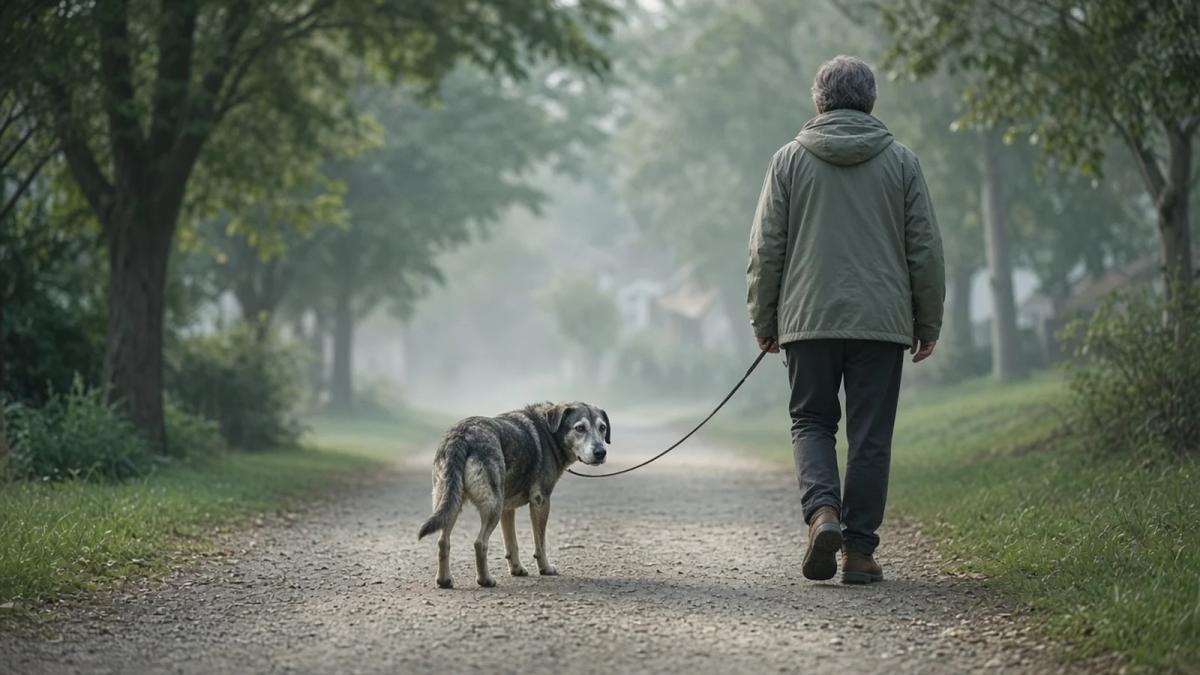
For anyone wondering whether the place we live leaves a mark on lifespan: what the Dog Aging Project's initial survival analysis shows in animals that share human environments, and why it does not yet point to a cause.
Anyone who has lived with a dog has watched a whole life pass in a fraction of a human one: puppyhood, prime, a greying muzzle. That speed is what makes dogs useful to people who study ageing. Companion dogs share human environments, develop similar age-related diseases and have compressed lifespans, which is why the authors of a new study call them a valuable model for the science of ageing.
The study, by Chiu, Dunbar, Han and colleagues, was published online in GeroScience on 27 October 2026. It is the initial survival analysis of the Dog Aging Project, a large prospective cohort of companion dogs. The team analysed 41,047 dogs with baseline answers to the Health and Life Experience Survey, a long questionnaire filled in by owners, and followed deaths through 2024. Dates of death were reported by owners.
How long did the dogs live, and who lived longer?
Median lifespan ranged from 14 years in small dogs to less than 10 years in giant dogs of breeds recognised by the American Kennel Club (AKC). The median is the age by which half of the dogs in a group had died.
Two other differences were smaller. Comparing dogs of the same size and sex, those of AKC-recognised breeds lived modestly shorter lives than non-AKC and mixed-breed dogs. Separately, females lived slightly longer than males.
These baseline differences shape everything that follows. Before looking at geography or daily life, the analysis has to account for size, breed background and sex; otherwise a region with many giant dogs would simply look like a region where dogs die young.
Does where a dog lives make a difference?
After adjusting for size, breed background and sex, differences between rural, suburban and urban dogs were no longer evident. Differences between regions and between states, however, remained significant.
The comparison with people is the most striking part. The state pattern of dog mortality correlated positively with the state pattern of human mortality: r = 0.43 and ρ = 0.63, with p = 0.0017. In plain terms, states where dogs tended to die earlier also tended to have higher human mortality; the link was moderate rather than tight, and the statistics make it unlikely to be a fluke of chance.
This is a correlation between states, not between households. It does not identify what in those states drives the pattern, and it says nothing about the risk of any individual dog, family or person.
What in a dog's daily life was linked to survival?
The team then screened 804 baseline survey questions in what they call a survey-wide association study. For each question, a statistical survival model (a Cox model) compared how quickly deaths accumulated across the answers, within groups of dogs with the same demographic profile. Because testing hundreds of questions guarantees some chance hits, the analysis used false-discovery-rate control, a correction that limits how many of the flagged results are likely to be noise.
Seventy-two baseline variables were associated with mortality. Most of them came from five areas of the questionnaire: health status, physical activity, behaviour, environment and diet. Many showed a clear exposure-response pattern, with risk changing step by step across levels of an answer.
The published abstract does not list the individual variables, so we do not name them here.
What is actually new?
The abstract does not compare its numbers with earlier studies, so the new part is what this analysis itself reports: the first survival results from this cohort, an overlap between dog and human mortality across states, and 72 survey variables that are now candidates for closer study. The difference in kind is the setting: tens of thousands of companion dogs living with their owners, not laboratory animals.
Why is none of this a cause yet?
Everything here is observational. The study reports associations: it does not establish the direction of any link or identify a factor that changes lifespan. Where an answer about physical activity tracks with survival, for instance, a dog may move less because it is already unwell, not the other way round. Dates of death came from owners, and the survey answers were baseline measures. The authors describe the survey-based health, behavioural and environmental factors as warranting targeted causal investigation.
The work was supported by US federal grants, including from the National Institute on Aging, and the authors declare no competing interests.
What should a reader take from it?
For now, nothing here is a basis for changing your own habits or your dog's. It is a reason to watch whether targeted studies can separate genuine environmental signals from other explanations, and whether the overlap between dog and human mortality across states can be traced to something specific that both share.
This material is for information only and does not replace a consultation with a doctor.
Sources
Chiu WA, Dunbar MD, Han G, et al.; Dog Aging Project Consortium. Factors associated with longevity in companion dogs: initial findings from the Dog Aging Project. GeroScience. 2026. PMID 42945030 · doi:10.1007/s11357-026-02448-9
What this piece relies on
Cards
Articles in this section are educational and are not medical advice, a diagnosis, or a prescription. Consult a qualified professional before acting on anything you read here.
Read next
 ResearchMedicine and treatment
Hormone replacement for absent parathyroids held up over 3.5 years
For adults with hypoparathyroidism who live on calcium and vitamin D tablets: what the longest follow-up of this daily hormone replacement found, and where the evidence still stops.
 ResearchBiomarkers
An eye photo predicts death risk almost as well as age
For anyone curious about AI tests of biological age: what a new retinal model adds to the oldest risk factor of all, which causes of death it reads best, and what it still cannot tell one person.
 ResearchMedicine and treatment
Knees, cholesterol and an AI ECG: what four new trials showed
4 stories this week: knee osteoarthritis with obesity, a cholesterol-lowering strategy in artery disease, AI screening for heart rhythm problems and clots around arm catheters. Four randomised trials, each with what it does not yet show.
Digest · 4 stories