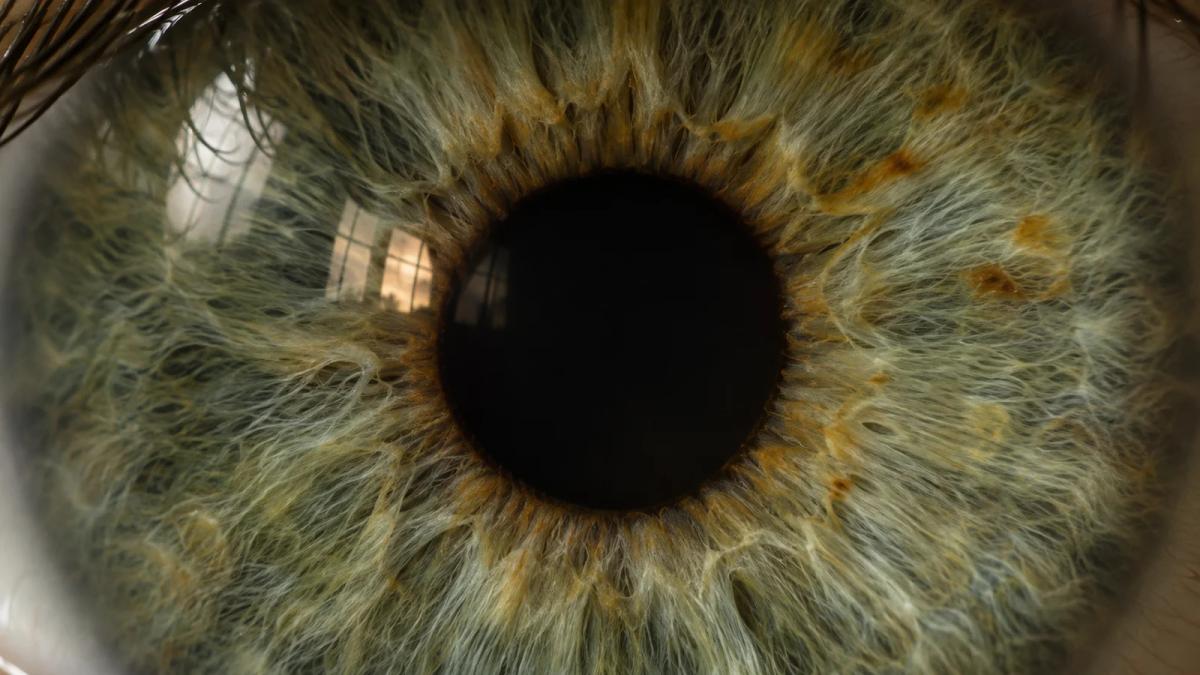
For anyone curious about AI tests of biological age: what a new retinal model adds to the oldest risk factor of all, which causes of death it reads best, and what it still cannot tell one person.
Researchers in Singapore have trained a deep-learning model to read an ordinary colour photograph of the back of the eye and turn it into one number tied to the risk of dying. They call it RetiME, the Retinal Mortality Equivalent. In a held-out group of 42,266 UK Biobank participants, average age 56, followed for about 12.5 years, 651 people died. In the unadjusted model, each step of one standard deviation up the score went with a 2.5-fold higher risk of death (hazard ratio 2.50), close to the risk carried by being one standard deviation older (2.63). The study was published in Nature Biomedical Engineering on 2 November.
The retina shows small blood vessels without a needle
Arteries, veins and nerve tissue of the retina can be photographed through the pupil with a fundus camera, without blood tests or radiation. Earlier work went through an intermediate step: a model estimated "retinal age", and researchers looked at the gap from real age. In a UK Biobank analysis published in 2023, each extra year of that gap was linked to only a 2% higher risk of death. RetiME skips the age step and maps retinal features directly to the risk of death. When the authors looked at where the model directed its attention, photographs of people who later died drew more of it to the vessels.
On three other continents the signal held, but it was weaker
The score was checked in three cohorts it had never seen: 9,413 adults in the Singapore Epidemiology of Eye Diseases study, followed for an average of 15.4 years (2,259 deaths); 4,579 people in the Ural Eye and Medical Study in Russia (450 deaths); and 1,102 participants of the US Age-Related Eye Disease Study (98 deaths), whose photographs were taken on slide film. Every cohort used a different camera.
In all four groups a higher score meant a higher risk of death. Predictive accuracy is measured by the C-index, where 0.5 is a coin toss and 1.0 is a perfect forecast. For RetiME it was between 0.70 and 0.74 in the UK, Singapore and Ural groups and 0.60 in the American one; age alone scored higher in each of them (0.72, 0.77, 0.72 and 0.66).
What the photograph adds on top of age is modest
For any risk test the deciding question is what it adds to what a doctor already knows, and the first thing a doctor knows is age. Once age was taken into account, each standard deviation of RetiME carried a 53% higher risk of death in the UK test set, 21% in Singapore, 18% in the Ural cohort and 37% in the American study. Adding the score to age raised the C-index by between 0.001 and 0.028: from 0.723 to 0.730 in the UK, from 0.772 to 0.773 in Singapore, from 0.724 to 0.728 in the Ural cohort and from 0.661 to 0.689 in the American study.
Among people aged 40 to 60, where age itself separates risk less sharply, the photograph did slightly better than age in the UK set (0.676 versus 0.662). For comparison, in the same UK participants grip strength was not significantly linked to death (hazard ratio 1.07), while telomere length, though linked to death, separated those who died from those who survived much less well (C-index 0.593).
Heart disease showed up in the eye more reliably than other causes of death
In UK Biobank a higher score was linked to death from ischaemic heart disease, lung cancer, dementia, stroke and chronic lung disease, even after adjustment for age, sex, smoking, blood pressure, alcohol and body mass index. In Singapore, after adjustment for age and sex, only the heart link held (hazard ratio 1.55 per standard deviation); for stroke, chronic lung disease and dementia the association disappeared, although there were only 11 dementia deaths. In predicting heart attacks in the UK set, the score together with age and sex (C-index 0.695) did not beat the Framingham risk score (0.704). For stroke it did better than both Framingham and the American Pooled Cohort Equations (0.698 against 0.654 and 0.673).
A forecast, not yet a check-up
All of this is observational. The score predicts; it does not show that anything in the retina causes death or that changing it would help. The model was trained on a European cohort, and all three external test groups came from eye studies. The authors themselves conclude that retinal imaging deserves further evaluation as one component of a broader assessment of mortality risk.
Four authors are named on a provisional patent application filed by the National University of Singapore that covers the method. The work was funded by Singapore's National Medical Research Council and the NUS-NUHS Ageing and Longevity programme.
If a clinic offers an "eye age" or similar AI test, it is worth discussing with a doctor what decision the result would actually change. For now the photograph adds a little to what age already says, and it reads the heart more reliably than other causes of death; whether it can guide anything a person does is the question the next studies will have to answer.
More on how age models built from scans and ECGs are made, and what they measure: Biological age from a CT scan, an ECG or an X-ray: what the new age models measure.
This material is for information only and does not replace a consultation with a doctor.
Sources
Xu T, Peng Q, Li H, et al. Re-timing mortality risk through individualized modelling of lifespan trajectories. Nature Biomedical Engineering. 2026. PMID 42972028, doi:10.1038/s41551-026-01822-4
Zhu Z, Shi D, Guankai P, et al. Retinal age gap as a predictive biomarker for mortality risk. British Journal of Ophthalmology. 2023. PMID 35042683, doi:10.1136/bjophthalmol-2021-319807
What this piece relies on
Cards
Articles in this section are educational and are not medical advice, a diagnosis, or a prescription. Consult a qualified professional before acting on anything you read here.
Read next
 ResearchMedicine and treatment
Hormone replacement for absent parathyroids held up over 3.5 years
For adults with hypoparathyroidism who live on calcium and vitamin D tablets: what the longest follow-up of this daily hormone replacement found, and where the evidence still stops.
 ResearchMedicine and treatment
Knees, cholesterol and an AI ECG: what four new trials showed
4 stories this week: knee osteoarthritis with obesity, a cholesterol-lowering strategy in artery disease, AI screening for heart rhythm problems and clots around arm catheters. Four randomised trials, each with what it does not yet show.
Digest · 4 stories
 ResearchMedicine and treatment
Lactoferrin lost to plain iron for anaemia in pregnancy
For pregnant women with low iron weighing an alternative to standard tablets: what the largest blinded test found for mother and baby, and what it leaves open.