For anyone with knee osteoarthritis who is tempted to back up their exercises with a supplement: what a Japanese trial in older women showed, and why it is far from the final answer.
On 16 October 2026 the journal Medicine published a pilot randomised trial from Juntendo University in Tokyo. Researchers there enrolled 88 postmenopausal women aged 55 to 80 with symptomatic knee osteoarthritis, Kellgren–Lawrence grade 2 to 4 on X-ray, and asked a simple question: if a person is already doing exercises for the knee, does adding a vitamin make the result better? The women were randomly assigned to one of three groups for 24 weeks: home exercises alone, the same exercises plus eldecalcitol, an active form of vitamin D3 that is used in Japan to treat osteoporosis, or the same exercises plus vitamin E.
Three static movements, morning and evening
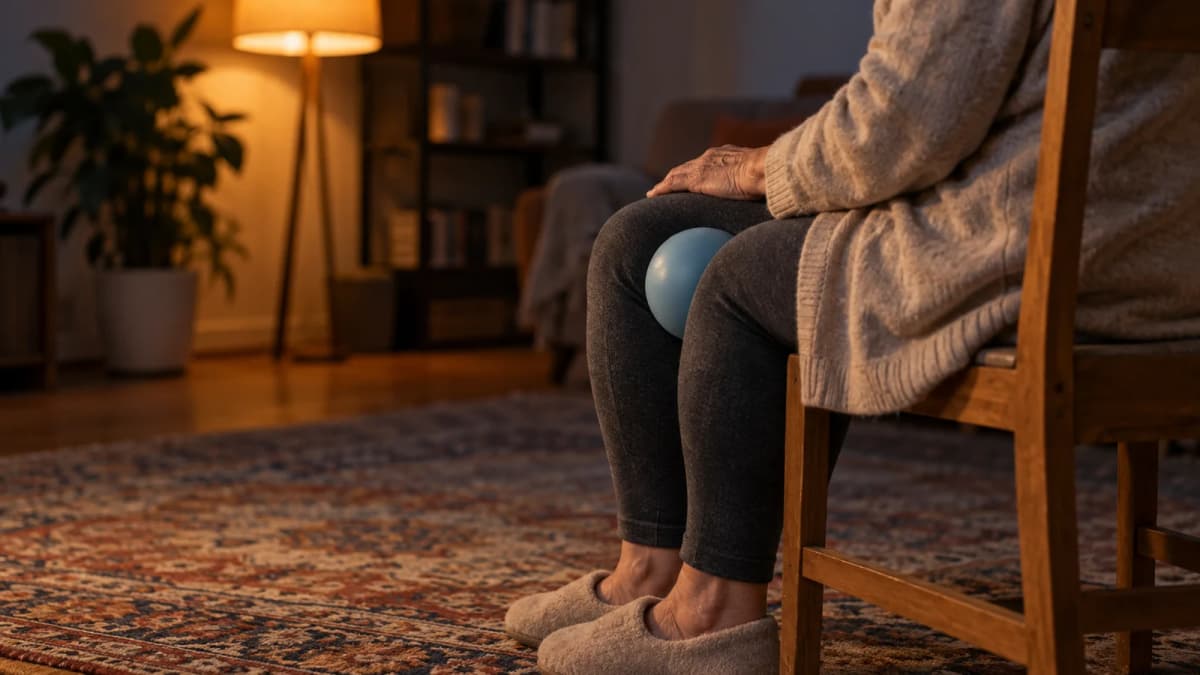
Physical therapists taught everyone the same three movements and gave them a brochure: raising a straight leg while lying on the back, lifting the leg to the side while lying on the side, and squeezing a ball between the knees while sitting. Each movement was a static contraction held for a few seconds, and the set was repeated in the morning and in the evening. Doctors checked at clinic visits that the exercises were being done.
Every group got better, including the one without pills
Of the 88 women, 80 finished the trial: 33 in the eldecalcitol group, 27 in the vitamin E group and 20 in the exercise-only group. The main measure was the Japanese Knee Osteoarthritis Measure (JKOM), a questionnaire on pain, stiffness and daily activities in which a lower score is better. Over six months the score fell from 35.2 to 21.7 with eldecalcitol, from 34.9 to 23.8 with vitamin E and from 33.6 to 17.0 with exercise alone. Quadriceps strength rose in every group, in the exercise-only group from 15.9 to 20.7 kilograms of force, and a 10-metre walk became faster in every group.
The comparison between groups is what the trial was built for, and there the vitamins made no measurable difference. The groups did not differ in knee symptoms, quality of life on the SF-36 questionnaire, muscle strength or walking speed. Grip strength rose significantly only in the eldecalcitol group, from 17.5 to 19.3 kilograms, and inflammation markers in the blood fell only in the vitamin E group, but in neither case was the change different from the other groups. The only difference between groups that the authors report is in bone mineral density.
Earlier vitamin D trials tested pain and cartilage over two years
The Tokyo study tested eldecalcitol alongside home exercise in knee osteoarthritis. Ordinary vitamin D3 (cholecalciferol) has been tested before in placebo-controlled trials. In a two-year trial in the United States, published in JAMA in 2013, 146 people with painful knee osteoarthritis took vitamin D or a placebo; knee pain and the loss of cartilage volume on MRI were the same in both groups. In a two-year trial in Tasmania, published in JAMA in 2016, 413 people with knee osteoarthritis and low vitamin D levels were randomised to vitamin D3 or a placebo, and there was no significant difference in cartilage volume or knee pain.
Exercise, by contrast, sits at the centre of clinical guidelines. The 2019 guidelines of the Osteoarthritis Research Society International list education and structured land-based exercise, with or without weight management, as core treatments for knee osteoarthritis. The 2019 guideline of the American College of Rheumatology and the Arthritis Foundation strongly recommends exercise for osteoarthritis of the knee and hip.
Built to test feasibility, not to settle the question
This was a pilot study: the number of participants was not calculated to detect a difference between groups, and the authors themselves write that it was too small to assess how well the vitamins work. Only women took part, the treatment lasted six months, and the analysis included only those who finished the trial. The groups also ended up uneven: the exercise-only group was the smallest and had one woman with the most severe grade of knee damage, compared with ten in each vitamin group. The trial had no external funding, and the authors declare no conflicts of interest.
So the result does not prove that the vitamins are useless for the knee. Among the 80 women who completed this trial, adding either vitamin to the exercise programme produced no measurable difference from exercise alone. The trial had no group without exercise, so it cannot say how much of the improvement came from the exercises themselves.
If you have knee osteoarthritis, regular exercise is the part of treatment with the strongest backing, and a supplement is not a substitute for it. Whether you need vitamin D or a medicine for bone health is a separate question; discuss it with your doctor.
This article is for information only and does not replace a consultation with a doctor. Nothing in it is a recommendation to start, stop or change any treatment.
Sources
Kanazawa H, et al. Additive effects of active vitamin D3 or vitamin E administration on therapeutic lower-limb home exercise for knee osteoarthritis: A pilot prospective randomized controlled trial. Medicine (Baltimore). 2026. PMID 42888606
McAlindon T, et al. Effect of vitamin D supplementation on progression of knee pain and cartilage volume loss in patients with symptomatic osteoarthritis: a randomized controlled trial. JAMA. 2013. PMID 23299607
Jin X, et al. Effect of Vitamin D Supplementation on Tibial Cartilage Volume and Knee Pain Among Patients With Symptomatic Knee Osteoarthritis: A Randomized Clinical Trial. JAMA. 2016. PMID 26954409
Bannuru RR, et al. OARSI guidelines for the non-surgical management of knee, hip, and polyarticular osteoarthritis. Osteoarthritis Cartilage. 2019. PMID 31278997
Kolasinski SL, et al. 2019 American College of Rheumatology/Arthritis Foundation Guideline for the Management of Osteoarthritis of the Hand, Hip, and Knee. Arthritis Care Res (Hoboken). 2020. PMID 31908149
What this piece relies on
Cards
Articles in this section are educational and are not medical advice, a diagnosis, or a prescription. Consult a qualified professional before acting on anything you read here.
Read next
 ResearchMedicine and treatment
Becoming active in midlife was linked to lower odds of frailty later
What a 22-year Greek cohort suggests about whether it is too late to become active in your 40s or 50s, and why the direction of your habits may say more than any single snapshot.
5 min read ResearchMedicine and treatment
From stroke to multiple sclerosis: four news stories on changing care
4 stories this week: stroke, type 2 diabetes in children, lung cancer and multiple sclerosis, each with who was studied, what was measured and where the evidence stops.
5 min readDigest · 4 stories
 ResearchMedicine and treatment
Adding a steroid to the asthma rescue puff meant fewer severe attacks
For people with asthma who reach for a reliever inhaler: what three randomised trials say about a reliever that also contains an anti-inflammatory steroid, and where that evidence is still thin.
5 min read