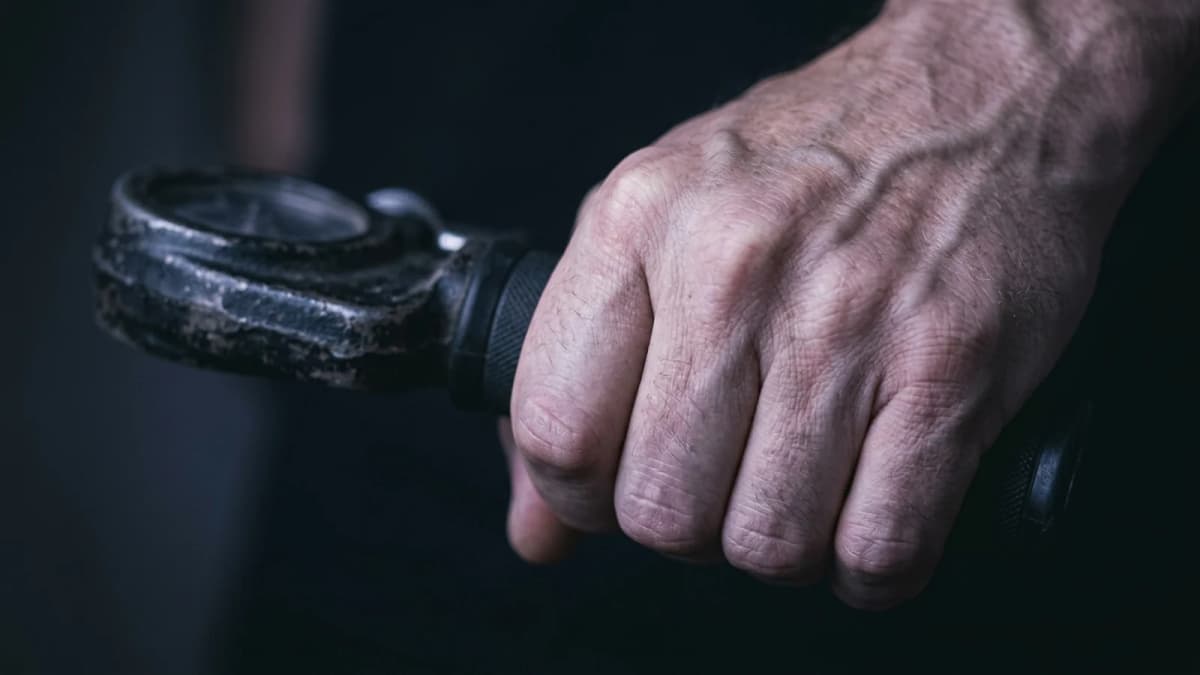
The dynamometer sits inside the sarcopenia definition, the frailty phenotype and preoperative assessment. What is actually measured there, why cut-offs do not transfer between devices and countries — and why the association between weak grip and worse outcomes does not make grip a target.
A hand dynamometer is one of the cheapest instruments in a clinic: the measurement takes under a minute and needs no laboratory and no consumables. Yet grip strength does not sit in the "interesting facts" section — it sits inside working clinical definitions and scales. Below is where exactly it sits, what it means there, and, separately, what it does not mean.
For the general explainer — what grip strength is and how it is measured — see “Grip strength: a simple biomarker of healthy ageing”. This article is about the clinical use.
First, comparability: why two numbers "in kilograms" are not the same number
Before comparing anyone's result against a cut-off, you need three things: which device measured it, in which posture, and which repetition was taken.
The cut-offs cited in consensus documents are calibrated for a Jamar-type hydraulic dynamometer and the posture standardised by the American Society of Hand Therapists (ASHT): seated, shoulders adducted and neutrally rotated, elbow flexed at 90°, forearm neutral, wrist between 0 and 30° of dorsiflexion (Fess, ASHT, 1992; protocol as set out by Roberts et al., 2011).
Spring and electronic dynamometers give systematically different values. Compared head to head in the same people, a Jamar read several kilograms higher than a spring-loaded Smedley: 27.4 versus 23.4 kg in one study (Benton et al., 2022), with a systematic bias of about 3.1 kg in men and 2.6 kg in women in another (Kim et al., 2017). The first group states outright that device-specific cut-off points are needed.
This is not pedantry. The gap between devices is of the same order as the distance from a normal value to the sarcopenia cut-off.
Sarcopenia: grip is the entry criterion, not an add-on
The European Working Group on Sarcopenia in Older People (EWGSOP2, 2019 consensus) restructured the definition so that low muscle strength became the primary parameter: when it is found, sarcopenia is probable, and the diagnosis is then confirmed by low muscle quantity or quality. In practice this means the route to a diagnosis starts with a dynamometer, not with densitometry.
The grip strength cut-offs in that consensus: below 27 kg for men and below 16 kg for women. Values under the cut-off are grounds to suspect sarcopenia and to go further; on their own they are not a diagnosis.
Where those numbers come from matters. They are not an average of European older adults: the cut-offs are set as a T-score of −2.5 against the peak of young adults, computed across twelve British life-course studies — 49,964 participants aged 4 to 90 (Dodds et al., 2014). "Low" here means low compared with a healthy young person, not low for one's own age.
That a cut-off is tied to a population and a protocol rather than to physiology is clearest in the comparison with Asia. The Asian Working Group for Sarcopenia (2019 update) sets below 28 kg for men and below 18 kg for women — both numbers higher than the European ones, while the spring-loaded Smedley and a different posture are more common in Asian practice. Two consensus documents, two measurement systems, two different sets of numbers for the same condition.
Frailty: grip as one of five phenotype components
In the frailty phenotype proposed by Fried and colleagues in 2001, weakness is one of five components, alongside unintentional weight loss, self-reported exhaustion, slow walking speed and low physical activity. A person with three or more components is classed as frail, with one or two as pre-frail.
The phenotype was built on the Cardiovascular Health Study cohort: 5,317 men and women aged 65 and over. Weakness is operationalised precisely through grip strength — the lowest 20% of the distribution, adjusted for sex and body mass index.
One detail is often lost in retelling: the cut-off in this scale is relative. It is taken from the distribution within the cohort itself and is not an absolute number. The specific kilogram figures that later spread through the literature as "Fried's thresholds" are the fixed quantiles of that cohort. Carrying "the lowest 20%" over to another population changes what the criterion means.
A related marker — walking speed — is covered separately in “Gait speed”.
What the large cohorts show
Two observational studies produced most of what is known today about grip strength and outcomes.
PURE — a prospective cohort: 139,691 people with known vital status, 17 countries, aged 35 to 70, measured with a Jamar dynamometer under a standardised protocol. Each 5 kg decrease in grip strength was associated with a higher risk of death from any cause (hazard ratio 1.16), cardiovascular death (1.17), myocardial infarction (1.07) and stroke (1.09). No association was found with incident diabetes, hospitalisation for pneumonia or COPD, falls or fractures (Leong et al., 2015).
UK Biobank — 502,293 participants with grip data, aged 40 to 69. The same direction of association: all-cause, cardiovascular and respiratory mortality, COPD, all cancers combined and colorectal cancer in particular (Celis-Morales et al., 2018).
These are associations, not effects. The PURE authors state in the paper itself that separate research is needed to test whether improving strength reduces mortality and cardiovascular disease. We return to that below — it is the most important part.
Preoperative assessment: the association is described, a standard is not
In surgery, grip strength is used as one indicator of preoperative condition. A systematic review of 19 studies (2,194 patients) described an association between low grip strength and postoperative morbidity; findings on mortality and length of stay diverged between studies, and the authors could not perform a meta-analysis because definitions of weakness and of morbidity were inconsistent (Sultan et al., 2012). In a narrower population — patients with gastrointestinal tumours, 8 cohorts, 2,291 people — low preoperative grip strength was associated with complications (odds ratio 2.23) (Zhu et al., 2022).
Three caveats, without which the association reads stronger than it is:
these are observational data: an association, not a cause of complications;
there is no single preoperative cut-off — different studies use EWGSOP2, AWGS, percentages of a norm or quintiles, and these are different numbers;
the body of evidence is not homogeneous: this is not a geriatric meta-analysis, the ages in these studies are mixed, and the length-of-stay findings conflict.
It also matters that grip is not always part of a composite scale here: in the Fried phenotype it is one of five items, but surgical studies often analyse it on its own, while two widely used frailty scales — the Clinical Frailty Scale and the modified frailty index — do not use grip strength at all.
Oncology: the signal is real, and it is mostly not about grip
In oncology, sarcopenia is associated with poorer tolerance of systemic therapy and with survival — in patients with an established diagnosis. But it is worth being precise about how sarcopenia was measured in that work: in most cases not with a dynamometer but as muscle cross-sectional area on a CT slice at the third lumbar vertebra. In a review of 38 studies (7,843 patients with solid tumours), a low muscle index was associated with worse overall survival (hazard ratio 1.44) (Shachar et al., 2016).
Grip strength as a standalone marker in oncology is less well studied: in Versteeg et al. (2018) it was associated with overall survival but not with treatment toxicity.
There are no grounds to carry these results over to a healthy person who "measured their grip and got a low number" — the population is different. The reverse is equally untrue: normal grip strength does not rule out cancer. No screening consensus includes dynamometry in cancer detection, and PURE found no association between grip and incident cancer overall.
What grip strength does not tell you
This is the most important part, and it is written almost nowhere.
Grip is a marker, not a mechanism. It reflects overall muscle strength, nutritional status and neuromuscular condition. The hand itself does not act on prognosis.
An unpopular consequence follows. From the fact that low grip is associated with worse outcomes it does not follow that training which raises grip strength changes those outcomes. These are two different claims: the first an observation, the second an intervention, and the second requires its own trials with clinical outcomes.
Such trials exist, and so far they do not support the transfer. The largest randomised trial to date of home-based prehabilitation in older patients with frailty before elective surgery — 847 people across 13 centres — did not reduce complications: 50.1% in the prehabilitation arm versus 47.7% in the control arm (McIsaac et al., 2025). A network meta-analysis of 186 randomised trials (15,684 participants) gives an odds ratio of 0.50 for complications with exercise prehabilitation, but the authors themselves rate the certainty of that evidence as very low (McIsaac et al., 2025).
This is not an argument against physical activity. It is an argument against one specific substitution in reasoning: a strong association between a marker and an outcome does not make the marker a target.
One measurement is weaker than a series. The trend of a person's own value is more informative than comparing their single number against a population cut-off — provided every measurement used the same device and the same posture.
What to do with this
For a clinic, the value of grip is that it is cheap and reproducible: it works as an entry step in sarcopenia assessment and as an element of the frailty phenotype, but not as a standalone prognosis for an individual. The decision is made on the whole picture, never on one number.
For a person measuring their own grip, the most useful thing is to keep a series of measurements with the date and the device recorded. In the Lonevi personal record such measurements sit alongside the other indicators, and what you see is the series rather than a single point — how it is arranged. What the product does not do is set out in “Limits of the summary”.
This material is informational and does not replace a consultation with a doctor. The cut-offs given here come from clinical consensus documents and are applied by a specialist in the context of an individual patient.
Sources
Cruz-Jentoft A.J. et al. (2019). Sarcopenia: revised European consensus on definition and diagnosis. Age and Ageing, 48(1):16–31. doi:10.1093/ageing/afy169
Dodds R.M. et al. (2014). Grip strength across the life course: normative data from twelve British studies. PLoS ONE, 9(12):e113637. doi:10.1371/journal.pone.0113637
Chen L.-K. et al. (2020). Asian Working Group for Sarcopenia: 2019 consensus update on sarcopenia diagnosis and treatment. JAMDA, 21(3):300–307. doi:10.1016/j.jamda.2019.12.012
Fried L.P. et al. (2001). Frailty in older adults: evidence for a phenotype. The Journals of Gerontology Series A, 56(3):M146–M156. doi:10.1093/gerona/56.3.m146
Roberts H.C. et al. (2011). A review of the measurement of grip strength in clinical and epidemiological studies. Age and Ageing, 40(4):423–429. doi:10.1093/ageing/afr051
Benton M.J. et al. (2022). Comparison of hydraulic and pneumatic/spring hand dynamometers. PLoS ONE, 17(6):e0270132. doi:10.1371/journal.pone.0270132
Kim M. et al. (2017). Comparison of Smedley and Jamar dynamometers. Geriatrics & Gerontology International, 17(11):2089–2095. doi:10.1111/ggi.13027
Leong D.P. et al. (2015). Prognostic value of grip strength: findings from the PURE study. The Lancet, 386(9990):266–273. doi:10.1016/S0140-6736(14)62000-6
Celis-Morales C.A. et al. (2018). Associations of grip strength with cardiovascular, respiratory, and cancer outcomes and all cause mortality in UK Biobank. BMJ, 361:k1651. doi:10.1136/bmj.k1651
Sultan P., Hamilton M.A., Ackland G.L. (2012). Preoperative muscle weakness as defined by handgrip strength and postoperative outcomes: a systematic review. BMC Anesthesiology, 12:1. doi:10.1186/1471-2253-12-1
Zhu H. et al. (2022). Preoperative handgrip strength and postoperative outcomes in gastrointestinal cancer surgery. Supportive Care in Cancer, 30:6451–6462. doi:10.1007/s00520-022-07047-w
Shachar S.S. et al. (2016). Prognostic value of sarcopenia in adults with solid tumours: a meta-analysis. European Journal of Cancer, 57:58–67. doi:10.1016/j.ejca.2015.12.030
McIsaac D.I. et al. (2025). Home-based prehabilitation before elective surgery in older adults with frailty (PREPARE): a randomised clinical trial. JAMA Surgery. doi:10.1001/jamasurg.2025.5288
McIsaac D.I. et al. (2025). Prehabilitation and postoperative outcomes: systematic review and network meta-analysis. BMJ, 388:e081164. doi:10.1136/bmj-2024-081164
Articles in this section are educational and are not medical advice, a diagnosis, or a prescription. Consult a qualified professional before acting on anything you read here.
Read next
 ExplainerMedicine and treatment
Low TSH and low free T4: when the problem is the signal, not the thyroid
A low TSH usually means too much thyroid hormone, so a low free T4 next to it looks wrong. What can produce this pattern, from central hypothyroidism to serious illness, medicines and biotin, and what doctors usually check next.
7 min read ExplainerBiomarkers
High ferritin: when it means iron overload and what treatment trials showed
A high ferritin is often read as iron overload, but in referred patients it frequently is not. Transferrin saturation sorts the possibilities. Blood removal is standard for haemochromatosis without hard-outcome trials, and in metabolic high ferritin trials found no benefit.
7 min read ExplainerBiomarkers
Small red blood cells, normal hemoglobin: what a low MCV means and what is checked next
A low MCV with normal hemoglobin can point to one of two different things: iron deficiency that has not yet become anemia, or an inherited thalassemia trait. Why ferritin is read together with CRP, which cut-offs apply, what blood-count indices can and cannot tell, and what the trials of iron without anemia found.
10 min read