Extra blood test could skip 7 in 10 prostate MRIs but delay 4 in 10 cancers
For men whose PSA sits just below the usual alarm level: what a second blood test before MRI changed in a Swedish screening trial, what it cost in later diagnoses, and why it is not yet routine.
On 22 October 2026 the journal European Urology Open Science published a test of a narrow but practical question from Göteborg-2, Sweden's population-based prostate cancer screening trial. In one of its randomised arms, men were sent for MRI not at the usual PSA level of 3 ng/ml but already from 1.8. The researchers took 555 of these men, median age 59, whose PSA fell between 1.80 and 2.99, and asked what would happen if a second blood test, the 4Kscore, decided who went on to MRI. In the study itself the score decided nothing: every man had the MRI anyway, and the authors modelled the strategy afterwards.
Why look below a PSA of 3 at all
In large earlier screening trials cited by the authors, such as the European ERSPC study, PSA screening with biopsy at 3 ng/ml or above reduced deaths from prostate cancer, but it also found tumours that would never have caused harm. The Swedish team had earlier reported that most men who were found to have advanced or very high-risk cancer at a repeat screening round had a PSA below 3 the time before. Lowering the threshold to 1.8 finds more cancers, the authors write, but in Göteborg-2 it raised the demand for MRI 2.6-fold and the detection of low-risk cancers 2.3-fold. The 4Kscore is one way to sort this grey zone: it combines age with four blood proteins — total, free and intact PSA and the enzyme hK2 — into an estimated risk of clinically significant cancer.
What the extra test changed
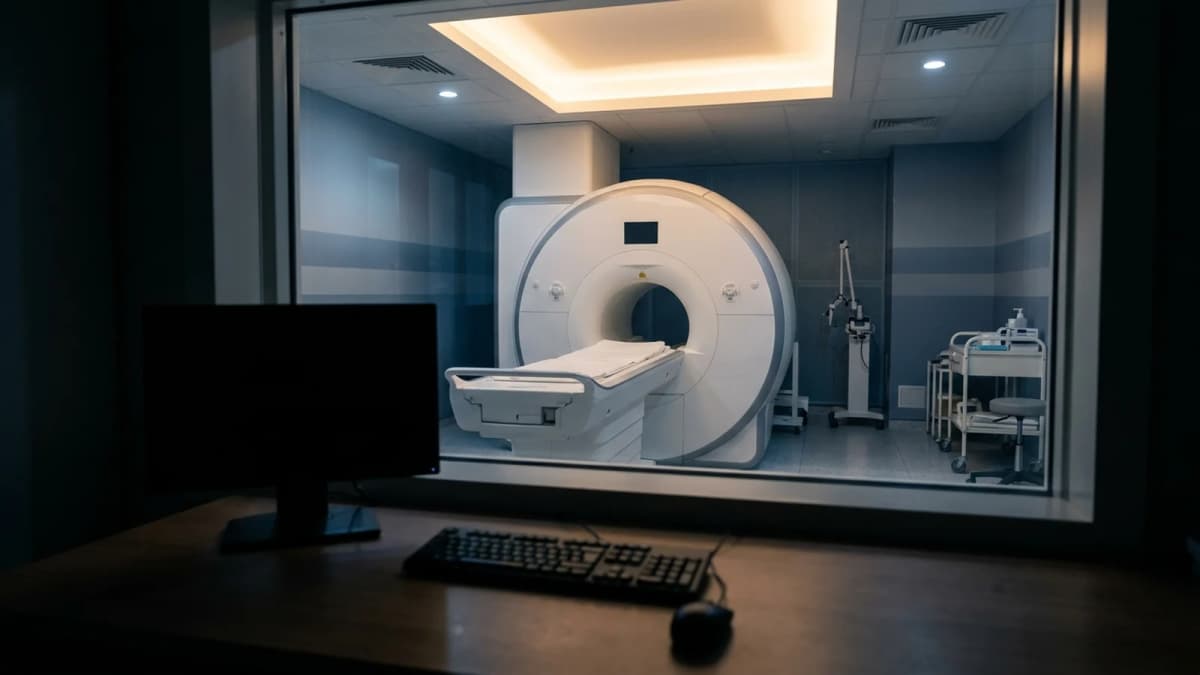
Every man in the analysis had an MRI regardless of his 4Kscore, which let the researchers see what the score would have missed. MRI was suspicious in 116 men (21%), and targeted biopsies found clinically significant cancer (ISUP grade 2 or higher) in 27 of the 555. With the cut-off fixed in advance at 7.5%, about 29% of men would have gone on to MRI. Per 1,000 men in this PSA range, that means 71% fewer MRIs, 67% fewer biopsies and 64% fewer diagnoses of low-grade ISUP grade 1 cancer. Of the men this strategy would have classed as negative, 97% had no significant cancer found along the MRI pathway.
The price: cancers that waited
The same cut-off found 56% of the significant cancers at this round; 12 of the 27 men with such tumours had a score below 7.5%. Per 1,000 men, 22 of 49 significant cancers and 4 of 9 cancers of grade 3 or higher would have been left for later screening rounds rather than found now. Most of the missed tumours were Gleason 3+4 with only a small high-grade component, but two were grade 3 or higher and two were stage pT3 at surgery, meaning the tumour had reached beyond the prostate. The authors describe the overall accuracy as moderate: an AUC of 0.69 (95% CI 0.58–0.79), where 0.5 is a coin toss and 1.0 is perfect. In the same trial, among men with PSA of 3 or above, the 4Kscore had worked better, with an AUC of 0.84. A lower cut-off of 5% would have halved MRI use, still found four of the five grade 3 or higher cancers, and cut low-grade diagnoses by 31%.
What the study does not show
This is a diagnostic accuracy analysis nested in a randomised screening trial, not a randomised comparison of the 4Kscore and not a trial of outcomes; only men with a suspicious MRI had a biopsy. It does not show whether finding these cancers earlier, or deferring them, changes anyone's chance of cure or survival; the authors say that question will be studied in the Göteborg-2 follow-up. Only 27 significant cancers were found, so the estimates are imprecise: the authors calculate that about 2,500 men would be needed to narrow the uncertainty around the AUC to roughly 0.1. The 4Kscore was not formally compared with simpler tools such as PSA density, its cost-effectiveness was not assessed, and it was measured in a separate blood sample taken at the MRI visit, so natural variation in PSA may have blurred some results. Only some eligible men took part, partly because of staffing limits during the COVID-19 pandemic. The work was funded by Swedish foundations, the Swedish Cancer Society and public research bodies in Sweden and the US, and the funders had no role in the analysis; one co-author is named on the patent behind the 4Kscore, receives royalties from the test and holds shares in the company that sells it.
A trade-off, not yet a rule
The authors' own conclusion is that lower cut-offs, longer follow-up and larger prospective studies are needed before this approach enters practice. For now the study describes a trade-off rather than a rule: a second blood test can spare most men in the PSA 1.8–3 range an MRI and a biopsy, at the cost of leaving a part of the significant cancers for the next screening round. If your PSA is in this range or you are weighing a 4Kscore or another additional test, discuss with your doctor what it would change in your case.
This material is for information only and does not replace a consultation with a doctor.
Sources
Möller F, Josefsson A, Månsson M, et al. 4Kscore as a pre-MRI reflex test for men with PSA 1.80–2.99 ng/ml in the Göteborg-2 prostate cancer screening trial. European Urology Open Science. 2026;94:43–51. PMID 42960148 · DOI 10.1016/j.euros.2026.10.001
Josefsson A, Månsson M, Kohestani K, et al. Performance of 4Kscore as a reflex test to prostate-specific antigen in the GÖTEBORG-2 prostate cancer screening trial. European Urology. 2024;86(3):223–229. PMID 38772787 · DOI 10.1016/j.eururo.2024.04.037
What this piece relies on
Cards
Articles in this section are educational and are not medical advice, a diagnosis, or a prescription. Consult a qualified professional before acting on anything you read here.
Read next
 ResearchMedicine and treatment
Hormone replacement for absent parathyroids held up over 3.5 years
For adults with hypoparathyroidism who live on calcium and vitamin D tablets: what the longest follow-up of this daily hormone replacement found, and where the evidence still stops.
 ResearchBiomarkers
An eye photo predicts death risk almost as well as age
For anyone curious about AI tests of biological age: what a new retinal model adds to the oldest risk factor of all, which causes of death it reads best, and what it still cannot tell one person.
 ResearchMedicine and treatment
Knees, cholesterol and an AI ECG: what four new trials showed
4 stories this week: knee osteoarthritis with obesity, a cholesterol-lowering strategy in artery disease, AI screening for heart rhythm problems and clots around arm catheters. Four randomised trials, each with what it does not yet show.
Digest · 4 stories