For people who feel well and wonder whether a dementia blood test is worth taking: what 12 years of follow-up say a positive or a negative result can tell you, and where these tests are recommended today.
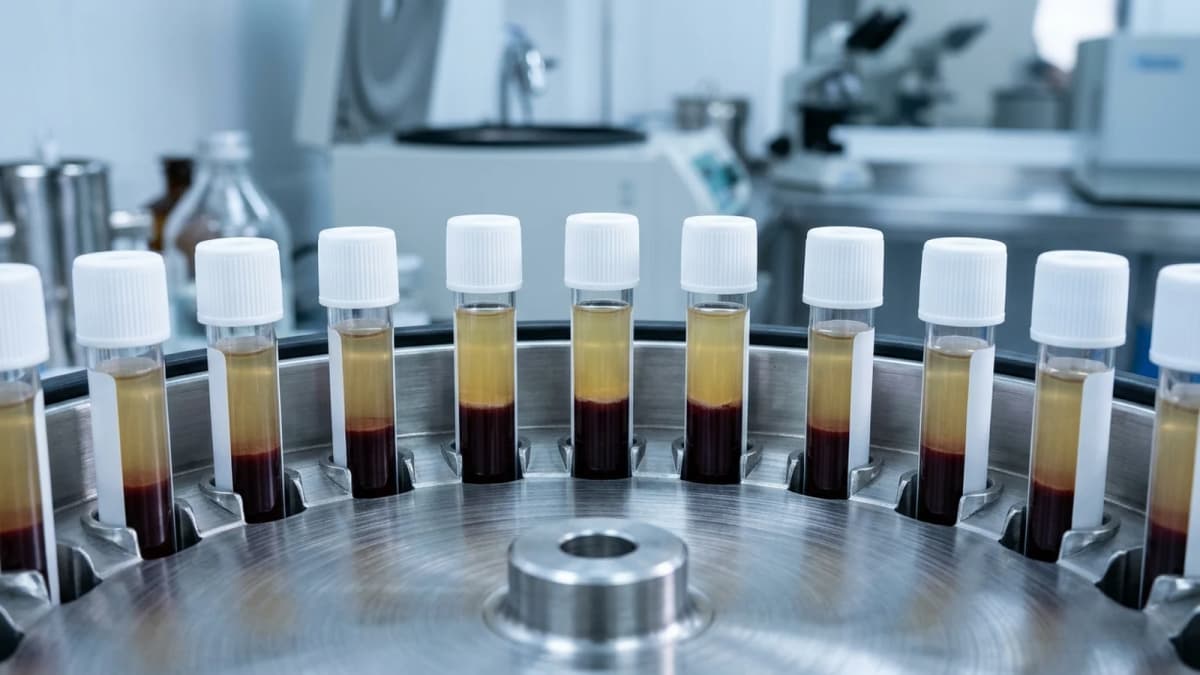
On 23 October 2026 the journal Neurology published a follow-up of 5,225 people from Whitehall II, a cohort of London civil servants studied since 1985. In 2012–2013 the participants, on average 69 years old and 27% of them women, gave blood that was frozen at −70°C. In 2024 a laboratory at the UK Dementia Research Institute measured five proteins in those samples: amyloid-beta 42 and 40 (analysed as a ratio), p-tau217, neurofilament light (NfL) and glial fibrillary acidic protein (GFAP). The team then checked national health records up to 2025 to see who had been diagnosed with dementia of any kind. Over a median of 12.2 years, 516 people had.
Each marker tracked with risk, p-tau217 most strongly
People whose results fell in the worst quarter for a given marker were diagnosed with dementia more often than the rest. For p-tau217 the hazard was 3.74 times higher (95% CI 3.12–4.50); for GFAP 2.25 times; for the amyloid ratio and for NfL 1.88 times each. As a measure of how well one number sorts people who will develop dementia from those who will not, the C-index ranged from 0.587 for the amyloid ratio to 0.693 for p-tau217 (0.5 is a coin toss, 1.0 is perfect). All the markers together reached 0.760.
A negative result reassured more than a positive one warned
Here the numbers explain why the authors call the predictive ability modest. Using the worst quarter as the cut-off, the markers picked up between 41.7% and 59.5% of the people who later developed dementia, so a large share of future cases had results that looked unremarkable. Among those flagged, only 16.4% to 23.5% went on to a dementia diagnosis during follow-up. The other side was stronger: 92.3% to 94.7% of people with a result outside the worst quarter remained free of a diagnosis, and specificity was 76.8% to 78.8%.
Ordinary risk factors did about as well
The second analysis matters most for anyone thinking of a test "just to know". A model built only from information a doctor already has — age, sex, ethnicity, education, smoking, physical activity, body mass index, kidney function, high blood pressure, type 2 diabetes, and heart disease or stroke — reached a C-index of 0.765, much the same as all the blood markers together. Adding the markers to that model raised it to 0.813: an improvement, but not a different league.
What the study does not show
It is an observational cohort, not a trial of testing: no one received results or treatment, so it says nothing about whether knowing a number helps anyone. Dementia was identified from linked electronic health records, and the authors note that milder cases may have been missed. The cohort began with London civil servants, only 27% of participants were women and most were White, so the authors say it is unclear how well the findings apply to other groups. The outcome was dementia of any cause: incomplete data on its causes did not allow separate analysis of Alzheimer's disease or other types. Whitehall II is supported by the US National Institute on Aging, the UK Medical Research Council and Wellcome.
Where blood tests stand today
The finding fits current guidance rather than contradicting it. In 2025 the Alzheimer's Association issued its first clinical practice guideline on blood biomarkers: it covers people with objectively confirmed cognitive impairment, from mild cognitive impairment to dementia, who are assessed by memory specialists when Alzheimer's disease is suspected. A test with at least 90% sensitivity and 75% specificity may be used for triage, and one with at least 90% for both may replace an amyloid PET scan or spinal fluid testing, always as part of a full diagnostic workup. The panel warns that many commercial tests, especially those using a single cut-off, do not meet these thresholds. The guideline makes no recommendations for people without cognitive impairment. The Whitehall II authors themselves see a possible role as a first filter in population settings, choosing who should be examined further, rather than as a personal forecast.
If you are considering such a test without symptoms, or have already received a result, discuss with your doctor what it can and cannot tell you in your situation.
This article is for information only and does not replace a consultation with a doctor.
Sources
Sabia S, Dumurgier J, Cavaillès C, et al. Blood-based biomarkers as predictors of all-cause dementia: a 13-year follow-up in the Whitehall II cohort study. Neurology. 2026;107(10):e218681. PMID 42913444 · DOI 10.1212/WNL.0000000000218681
Palmqvist S, Whitson HE, et al. Alzheimer's Association clinical practice guideline on the use of blood-based biomarkers in the diagnostic workup of suspected Alzheimer's disease within specialized care settings. Alzheimer's & Dementia. 2025. PMID 40729527
What this piece relies on
Cards
Articles in this section are educational and are not medical advice, a diagnosis, or a prescription. Consult a qualified professional before acting on anything you read here.
Read next
 ResearchMedicine and treatment
Hormone replacement for absent parathyroids held up over 3.5 years
For adults with hypoparathyroidism who live on calcium and vitamin D tablets: what the longest follow-up of this daily hormone replacement found, and where the evidence still stops.
 ResearchBiomarkers
An eye photo predicts death risk almost as well as age
For anyone curious about AI tests of biological age: what a new retinal model adds to the oldest risk factor of all, which causes of death it reads best, and what it still cannot tell one person.
 ResearchMedicine and treatment
Knees, cholesterol and an AI ECG: what four new trials showed
4 stories this week: knee osteoarthritis with obesity, a cholesterol-lowering strategy in artery disease, AI screening for heart rhythm problems and clots around arm catheters. Four randomised trials, each with what it does not yet show.
Digest · 4 stories