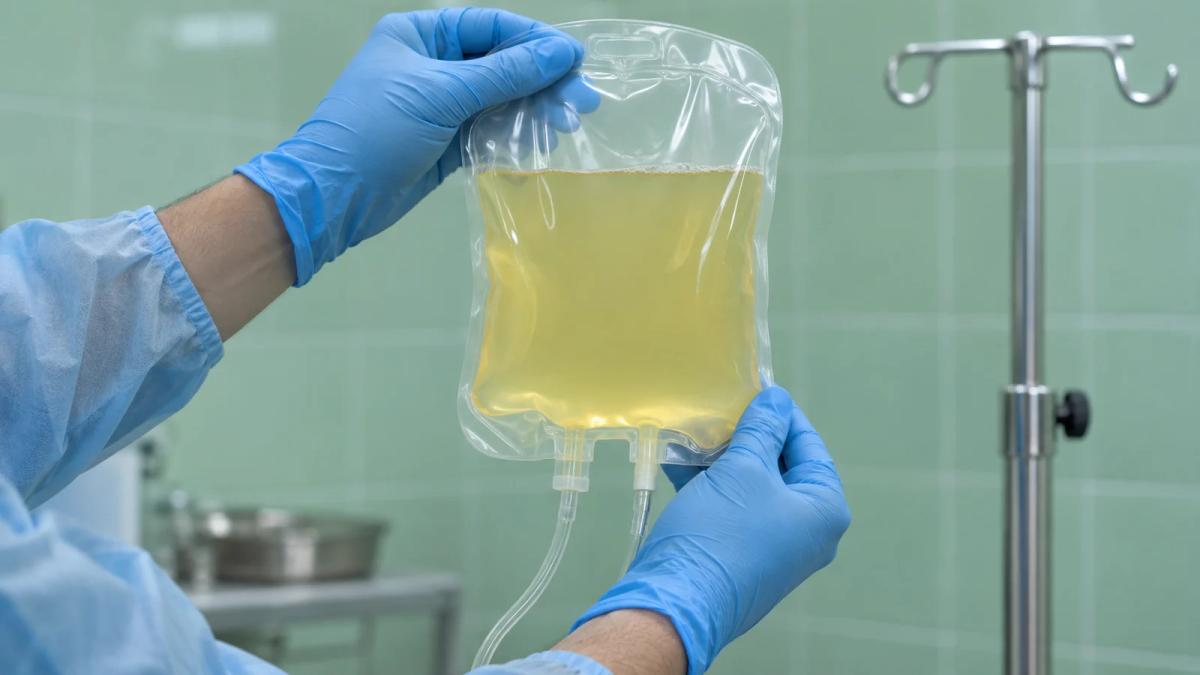
Plasma exchange doubled 30-day survival in a small liver failure trial
For families of people in hospital with alcohol-related liver failure: what a 100-patient trial shows, and why its first-month result is not yet the last word.
Researchers at SMS Medical College and Hospitals in Jaipur, India, randomly assigned 100 patients in hospital with alcohol-related acute-on-chronic liver failure to standard medical therapy alone or to the same care plus up to three sessions of therapeutic plasma exchange. The results were published online on 28 October 2026 in the European Journal of Gastroenterology & Hepatology.
What is being washed out of the blood?
Acute-on-chronic liver failure is a sudden, severe deterioration in a person who already has chronic liver disease; the authors describe it as a condition with high short-term mortality and few treatment options. Plasma exchange is a procedure in which the patient's plasma, the liquid part of the blood, is removed and replaced. The authors tested whether removing inflammatory mediators in this way might improve outcomes, noting that randomised evidence in this condition is limited.
How large was the difference in survival?
All 100 patients, 50 in each group, completed follow-up. Death in hospital occurred in 24% of the plasma exchange group and in 52% of the standard care group (p=0.007), an absolute difference of 28 percentage points; by the authors' calculation, about 3.6 patients needed the procedure for one additional patient to leave hospital alive. At 30 days, 72% and 36% were alive (p<0.001), and the adjusted hazard ratio for death was 0.43.
Disease severity scores improved more with plasma exchange: MELD-Na, the APASL ACLF Research Consortium score and the Child-Turcotte-Pugh score, together with INR, creatinine, lactate, ammonia and von Willebrand factor. The hospital stay was shorter, 19 days against 24 (p=0.023). The authors report no major adverse events related to the procedure.
Why one month of data in 100 patients is not the end of the story
A difference in mortality this large, found in 100 patients at SMS Medical College and Hospitals in Jaipur, needs to be repeated before it can be taken at face value. The abstract reports only in-hospital and 30-day outcomes. It does not say whether patients or doctors knew the assigned group, does not give a trial registration number and does not name a funder. All patients had alcohol-related disease, so the result says nothing directly about other causes.
An earlier and larger trial points the same way, with a caveat. At the All India Institute of Medical Sciences in New Delhi, 194 adults aged 18 to 60 with acute-on-chronic liver failure of different causes were randomly assigned in a single-centre, open-label trial published in Hepatology in March 2026. Mortality at 28 days was 44.3% with plasma exchange and 63.9% with standard care alone, but at 90 days it was similar between the groups. Whether the first-month gain in Jaipur lasts is still an open question.
What can a family take from this?
This is treatment in hospital for a critical condition, and it changes nothing about everyday liver health. For relatives of someone admitted with alcohol-related liver failure, it gives the hepatology team a concrete question: whether plasma exchange is available and considered appropriate. The authors themselves present it as an option where liver transplantation is limited. Whether it is used is a decision for the treating doctors; discuss it with them.
This article is for information only and does not replace a consultation with a doctor.
Sources
Sareen M, Sharma PN, Maharshi S, et al. Therapeutic plasma exchange improves survival in alcohol-related acute-on-chronic liver failure: a randomized controlled trial. Eur J Gastroenterol Hepatol, 2026;38(12):1413–1422, online 28 October 2026. doi:10.1097/MEG.0000000000003287 · PubMed 42992479
Swaroop S, Biswas S, Aggarwal A, et al. Therapeutic plasma exchange improves short-term survival in patients with acute-on-chronic liver failure: a randomized controlled trial. Hepatology, online 30 March 2026; registration CTRI/2022/01/039094. doi:10.1097/HEP.0000000000001755 · PubMed 41911559
What this piece relies on
Cards
Articles in this section are educational and are not medical advice, a diagnosis, or a prescription. Consult a qualified professional before acting on anything you read here.
Read next
 ResearchMedicine and treatment
Hormone replacement for absent parathyroids held up over 3.5 years
For adults with hypoparathyroidism who live on calcium and vitamin D tablets: what the longest follow-up of this daily hormone replacement found, and where the evidence still stops.
 ResearchBiomarkers
An eye photo predicts death risk almost as well as age
For anyone curious about AI tests of biological age: what a new retinal model adds to the oldest risk factor of all, which causes of death it reads best, and what it still cannot tell one person.
 ResearchMedicine and treatment
Knees, cholesterol and an AI ECG: what four new trials showed
4 stories this week: knee osteoarthritis with obesity, a cholesterol-lowering strategy in artery disease, AI screening for heart rhythm problems and clots around arm catheters. Four randomised trials, each with what it does not yet show.
Digest · 4 stories