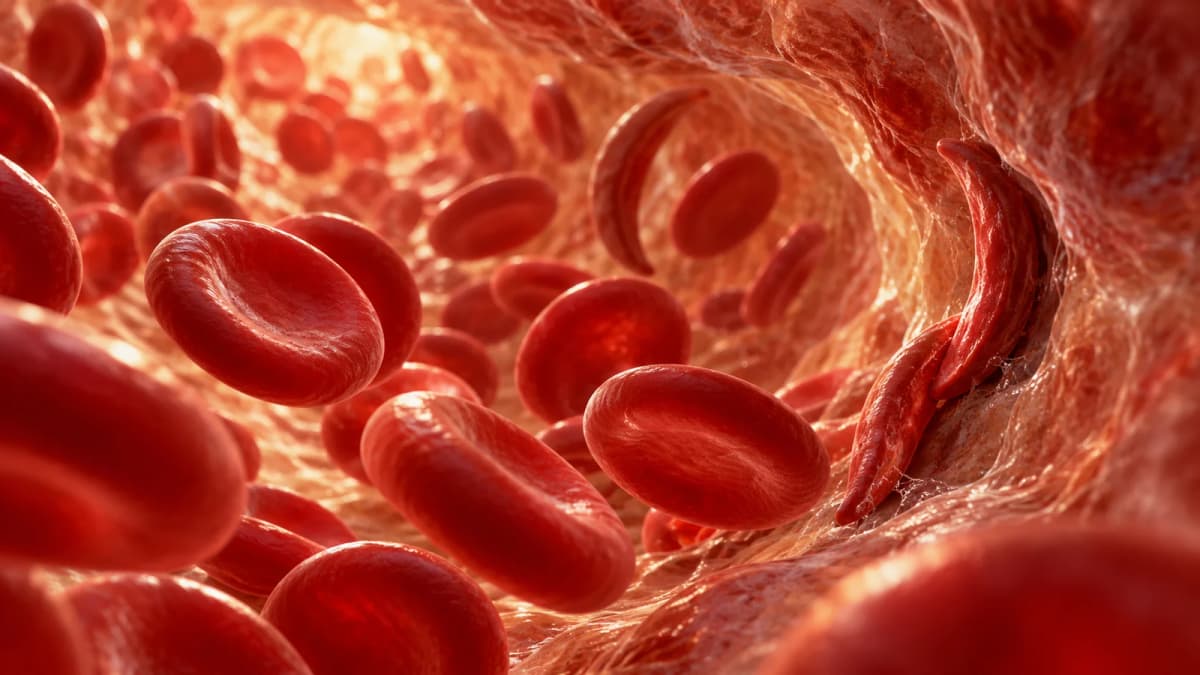
For families living with sickle cell disease: what a year-long placebo-controlled trial adds about easing the anaemia, and why it is not yet an answer to pain.
On 24 October 2026 The Lancet published the results of RISE UP, a phase 3 trial of mitapivat, a tablet already approved in the US and the EU for two other inherited anaemias, pyruvate kinase deficiency and thalassaemia, but not for sickle cell disease. The trial ran at 69 sites in 15 countries and enrolled 207 people older than 16 with sickle cell disease, anaemia and recurrent pain crises. They were randomly assigned, two to one, to mitapivat or placebo in a double-blind trial.
The drug works on the red cell's energy supply
Sickle cell disease is an inherited blood disorder caused by abnormal haemoglobin, the protein in red blood cells that carries oxygen. The red cells break down early, which causes chronic anaemia, and they tend to stiffen into a sickle shape and block small vessels, which causes episodes of severe pain. Mitapivat activates pyruvate kinase, an enzyme of the red cell's energy metabolism: it raises the cell's ATP and lowers a molecule called 2,3-DPG. The authors expected this to ease the anaemia and reduce sickling.
Haemoglobin rose in four of ten, pain crises did not clearly fall
The trial had two primary endpoints. The first was a haemoglobin response: an average rise of at least 1.0 g/dL between week 24 and week 52 compared with the start. It was reached by 56 of 138 people on mitapivat (41%) and by 2 of 69 on placebo (3%), an adjusted difference of 38 percentage points (95% CI 29–47).
The second was the yearly rate of sickle cell pain crises: 2.6 on mitapivat and 3.1 on placebo. The difference was not statistically significant (p = 0.12), so the trial did not show that the drug reduces pain crises.
Serious adverse events were reported in 20% of the mitapivat group and 29% of the placebo group; one participant on mitapivat and none on placebo had a serious adverse event judged related to treatment.
What the trial does not show
A higher haemoglobin is a laboratory measure, not proof that people live longer or with fewer complications. RISE UP met one of its two primary endpoints, and its published abstract reports no results on organ damage or survival. One year is short for a lifelong disease; the open-label extension, in which participants continue treatment, is still running. The trial was funded by the manufacturer, Agios Pharmaceuticals, and several of the authors are its employees. The authors call mitapivat a potential disease-modifying treatment; with the pain-crisis endpoint missed, that remains to be shown.
Caution here has a recent reason. Another drug for sickle cell disease, voxelotor, was withdrawn from all markets worldwide in September 2024 after safety signals in its trials. A phase 3 trial of voxelotor in 88 participants aged 12 or older with HbSS or HbSβ0-thalassaemia and active leg ulcers, published on 15 October 2026, found complete healing at 12 weeks in 6.7% on the drug and 7.0% on placebo, and sickle cell crises were reported as adverse events more often on voxelotor (44.4% versus 25.6%). Long follow-up and safety data matter as much as a laboratory result.
Where this leaves current care
The US expert panel report on sickle cell disease (2014) strongly recommends hydroxyurea for adults with three or more severe pain crises in a year, or with pain or chronic anaemia that interferes with daily life, and strongly recommends transfusion therapy for many patients. For sickle cell disease, mitapivat remains an investigational treatment. According to the manufacturer, the US Food and Drug Administration is reviewing an application for accelerated approval in this disease, with a PDUFA goal date of 1 November 2026. If you or your child live with sickle cell disease, it is reasonable to ask how the current treatment is working and whether a clinical trial could be relevant; discuss it with your haematologist.
This material is for information only and does not replace a consultation with a doctor. Nothing in it is a recommendation to start, stop or change treatment.
Sources
Andemariam B, et al. Efficacy and safety of mitapivat in patients with sickle cell disease (RISE UP): a phase 3, double-blind, global, randomised, placebo-controlled trial. Lancet. 2026. PMID 42913682
A Study Evaluating the Efficacy and Safety of Mitapivat (AG-348) in Participants With Sickle Cell Disease (RISE UP). ClinicalTrials.gov. NCT05031780
Ogutu B, et al. Phase 3, randomised, placebo-controlled trial of voxelotor for the resolution of leg ulcers in sickle cell disease: RESOLVE. Br J Haematol. 2026. PMID 42880978
Agios Pharmaceuticals. U.S. FDA grants Priority Review to Agios' sNDA for mitapivat in sickle cell disease. Press release, 7 July 2026. agios.com
US Food and Drug Administration. FDA approves treatment for anemia in adults with rare inherited disorder (Pyrukynd). fda.gov
US Food and Drug Administration. FDA approves first oral treatment for anemia in thalassemia, an inherited blood disorder (Aqvesme). fda.gov
European Medicines Agency. Pyrukynd (mitapivat): EPAR. ema.europa.eu
Yawn BP, et al. Management of sickle cell disease: summary of the 2014 evidence-based report by expert panel members. JAMA. 2014. PMID 25203083
What this piece relies on
Cards
Articles in this section are educational and are not medical advice, a diagnosis, or a prescription. Consult a qualified professional before acting on anything you read here.
Read next
 ResearchMedicine and treatment
Inflamed fatty liver may weigh on daily life, not just lab results
For anyone told they have fatty liver: what a European trial adds about whether the inflamed form is felt day to day, and why the answer is still tentative.
4 min read ResearchSleep
Hour-long daily naps linked to higher odds of death in older adults
A four-year study of older adults in Vietnam separates short naps from long habitual ones and shows how night sleep changes the picture, drawing a clear line between a warning sign and a proven cause.
5 min read ResearchMedicine and treatment
Kidney decline nearly halted in a phase 3 trial — plus 2 more stories
3 stories this week: an immune kidney disease, sleep apnoea with excess weight and AI that reads chest scans, each with who was studied and where the evidence stops.
5 min readDigest · 3 stories