What limits VO2max — lungs, heart or muscles — and how accurate the estimates are
VO2max is often described as a measure of the lungs. In healthy people the ceiling is set mostly by how much oxygen the heart and blood can deliver; the lungs become the limit only in particular situations. What changes with age, and how accurate lab tests, formulas and watches are.
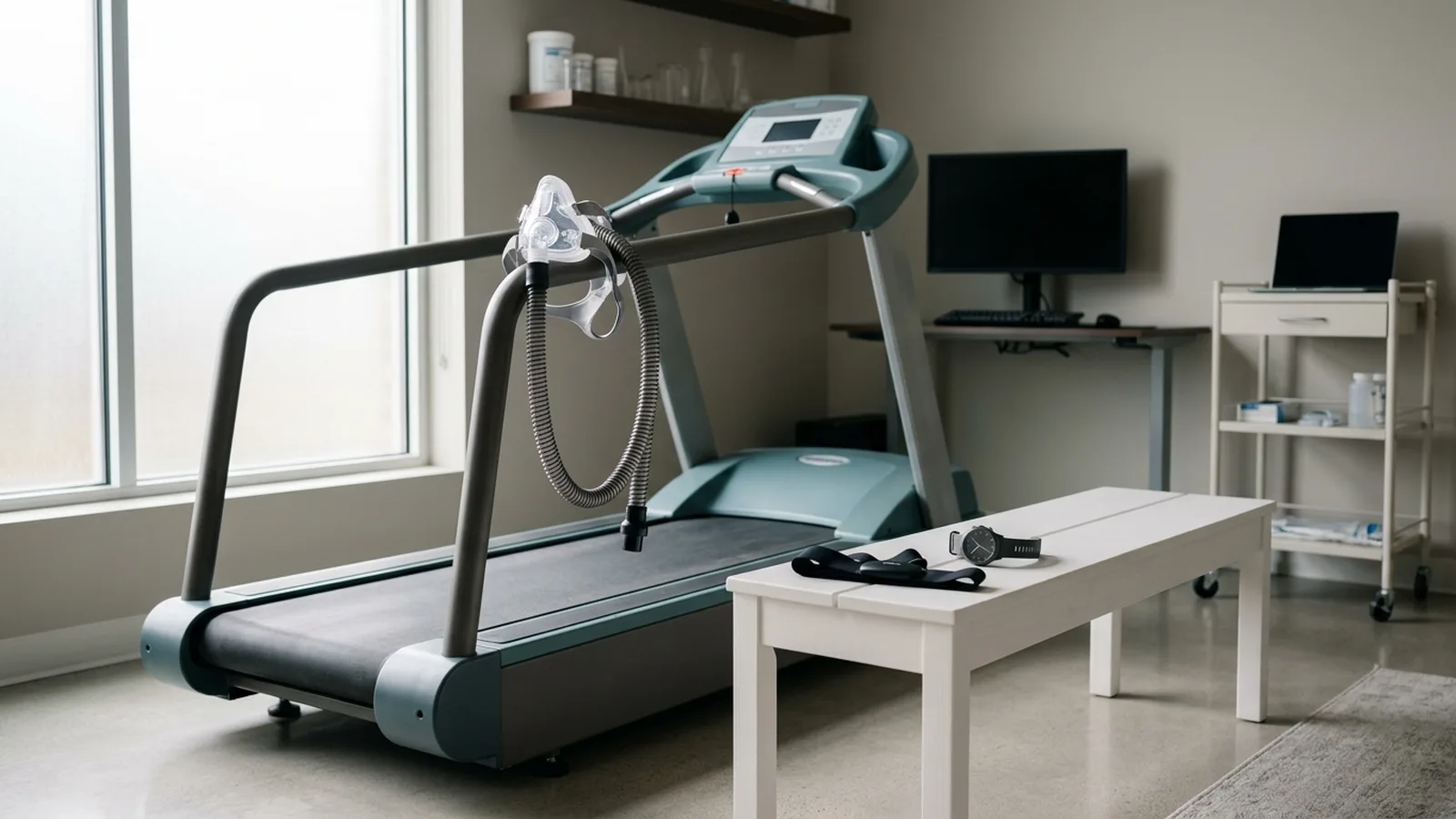
"VO2 max vs lung capacity" is one of the questions people bring to this measure, and it points at a real confusion. VO2max is often described as a measure of "how good your lungs are". Physiology says something more specific: in healthy people the ceiling is set mostly by how much oxygen the heart and blood can deliver, and the lungs become the limit only in particular situations. This piece covers what limits the number, what changes with age, and how accurate the different ways of getting it are — from a laboratory test to a watch.
How strongly the number is associated with lifespan is covered in a separate piece: VO2max and lifespan: how large the association is, and in whom. The basics of the measure are here.
One equation with three parts
Oxygen uptake obeys the Fick principle: it equals the amount of blood the heart pumps per minute (cardiac output) multiplied by how much oxygen the tissues take out of each litre of that blood (the arteriovenous oxygen difference). Cardiac output in turn is stroke volume multiplied by heart rate. Levine's 2008 review in the Journal of Physiology describes VO2max as a characteristic bounded by exactly these terms: how much blood the left ventricle ejects per beat, how fast it beats, and how much oxygen is extracted.
So one number hides a chain: the lungs load oxygen into the blood, the heart and blood carry it, the muscles extract and use it. The practical question is which link is the weakest.
What sets the ceiling in healthy people
The classic review by Bassett and Howley (2000) brings together three lines of evidence, and all three point to oxygen delivery, not extraction by muscle:
when delivery is changed deliberately — by blood doping, breathing less oxygen, or slowing the heart with beta-blockers — VO2max changes in the same direction;
the rise in VO2max with training comes mainly from a higher maximal cardiac output, not from greater extraction;
a small muscle group supplied with more blood than usual consumes oxygen at a very high rate — the muscle can take more than the whole body is able to bring it.
The authors conclude that delivery is the primary limiting factor for VO2max in exercising humans, while metabolic adaptations in muscle matter mainly for endurance below the maximum. Levine adds that elite endurance athletes owe their high VO2max chiefly to a high cardiac output from a large, compliant heart that fills quickly.
Blood itself is a vivid example. In a small experiment by Ekblom and colleagues (1976, five subjects), removing 800 ml of whole blood lowered VO2max from 4.27 to 4.03 l/min, and reinfusing the red cells about a month later raised it to 4.61 l/min. Maximal cardiac output, heart rate and stroke volume were the same in all three conditions. The heart did not pump more; after reinfusion the gain came in equal parts from more oxygen in arterial blood and from lower oxygen left in venous blood.
When the lungs do become the limit
In a large community sample the lungs do not look like the ceiling either. Among 2,314 Framingham Heart Study participants who had both a gas-analysis exercise test and lung function tests (McNeill et al., 2022), lower lung volumes and diffusing capacity went with lower peak oxygen uptake — each litre less of FEV1 with about 7% lower peak VO2 — but this is an association between people, not proof that the lungs set the limit; the authors themselves start from the premise that in most adults fitness is not limited by the mechanics of breathing. The clearer exception has a name — exercise-induced arterial hypoxaemia — and it has been described in trained and active people rather than in inactive ones.
In Dempsey's study (1984) of sixteen highly trained runners with an average VO2max of about 72 ml/kg/min, eight showed a fall in arterial oxygen tension of 21–35 mmHg at heavy and maximal exercise. Breathing mildly enriched oxygen corrected it; the authors attributed it most likely to a diffusion limitation when blood passes through the lungs very quickly.
In a study of twenty-nine healthy young women, most of them runners (Harms et al., 1998), a fall of more than 10 mmHg at maximal effort occurred in twenty-two, and almost half of those with significant hypoxaemia had a VO2max within 15% of predicted normal values (40–55 ml/kg/min). Inactive, less fit participants in that sample had no hypoxaemia.
So "the lungs limit VO2max" is true in a narrow sense: in part of trained athletes, and in these data in a noticeable share of active young women. It is not a description of how the number is limited in an ordinary healthy adult. Lung disease is a separate situation and is not covered by these studies.
What changes with age
VO2max falls with age, and the decline is not uniform. In the Baltimore Longitudinal Study of Aging (Fleg et al., 2005), peak oxygen uptake was measured repeatedly in 435 men and 375 women aged 21 to 87 without clinical heart disease, over a median of 7.9 years. The rate of decline rose from about 3–6% per decade in the twenties and thirties to more than 20% per decade in the seventies. Maximal heart rate fell by only 4–6% per decade, while the oxygen pulse — oxygen used per heartbeat — fell in step with VO2max itself.
Maximal heart rate declines predictably with age. In a meta-analysis of 351 studies with 18,712 participants and a laboratory study of 514 healthy adults (Tanaka et al., 2001), it was described by the equation 208 − 0.7 × age, not the familiar 220 − age, which underestimates it in older adults. It is a group equation: it describes the average, not a specific person.
What goes on inside a single person has been followed in the Dallas Bed Rest and Training Study. In 1966 five twenty-year-old men went through three weeks of strict bed rest and then eight weeks of heavy endurance training. Thirty years later (McGuire et al., 2001) their VO2max was 11% lower in litres per minute (per kilogram the fall was larger, from 43 to 31, because they had gained weight); maximal cardiac output had not changed because a lower maximal heart rate was offset by a larger stroke volume, and the whole decline came from reduced oxygen extraction. Six months of endurance training brought absolute VO2max back to their 1966 starting level — though not to the level they had reached after training at twenty — again through extraction. At forty years (McGavock et al., 2009) the picture had shifted: between 50 and 60 the decline was faster, and both central and peripheral components contributed. The net fall over forty years of life was comparable to the fall after three weeks of bed rest at age twenty — 27% versus 26%.
Five men is a very small group. These data show what is physiologically possible, not what happens on average, and they do not transfer to women or to people with disease.
VO2max or VO2peak
A true maximum is recognised by a plateau: the workload keeps rising, and oxygen uptake does not. Many people do not show a clear plateau, so laboratories use secondary criteria — the respiratory exchange ratio, heart rate close to the age-predicted maximum, blood lactate. In an experiment by Poole and colleagues (2008) in eight healthy men on a cycle ramp test, these criteria turned out to be unreliable: stopping at the most common exchange-ratio thresholds would have underestimated VO2max by 27% and 16%, while the heart-rate and lactate criteria would have rejected three and six of the eight participants, most of whom had in fact reached a plateau.
That is why reports increasingly say VO2peak — the highest value reached in this test — and some protocols add a short confirmation bout. It is not pedantry: the same person can receive two different numbers depending on when and why the test was stopped.
How much the number varies between tests
Even with direct gas analysis the number is not fixed. In a study by Katch and colleagues (1982), five trained people each did 8 to 20 treadmill tests over two to four weeks; the total spread was about ±5.6%, and more than 90% of it was the person's own day-to-day variability rather than equipment error. In a more recent study in ten moderately trained young men (Succi et al., 2023), repeatability was excellent — a coefficient of variation of about 2% and a minimal detectable difference of about 2.9 ml/kg/min.
The device matters too. In a study of 41 people — patients with heart failure and coronary disease plus ten healthy controls (Myers et al., 1991) — maximal oxygen uptake on treadmill protocols was on average 16% higher than on a cycle ergometer. Comparing a treadmill result with a cycle result is therefore not like with like.
Estimates without gas analysis
Most people never have a gas-analysis test. Their number comes from a formula, and each formula has a known error.
One-mile walk test (Kline et al., 1987) — What goes in: walk time, heart rate at the end, age, weight, sex — Accuracy in the development studies: 343 healthy adults aged 30–69; on the validation sample r = 0.92, standard error about 0.36 l/min
Non-exercise model (Jackson et al., 1990) — What goes in: sex, age, body composition, self-reported activity — Accuracy in the development studies: 2,009 people, under 10% women; standard error about 5.3–5.6 ml/kg/min
Non-exercise model, HUNT (Nes et al., 2011) — What goes in: age, waist, leisure activity, resting heart rate — Accuracy in the development studies: 4,260 in the final models (from 4,637 healthy Norwegians); standard error 5.70 ml/kg/min in men and 5.14 in women; 61% and 56% of variance explained
A standard error of about 5 ml/kg/min looks small, but for comparison the fiftieth percentile for men in their twenties in the US FRIEND registry is about 48 ml/kg/min and for men in their seventies about 24 (Kaminsky et al., 2015; treadmill tests in 7,783 adults without cardiovascular disease). An error of that size can move a person by a whole band on such a scale. Formulas work well for groups and less well for one person.
Watches
A watch also estimates rather than measures. In a meta-analysis of fourteen validation studies (Molina-Garcia et al., 2022) — 403 participants in total, mostly young adults with a pooled age of about 25:
devices whose algorithms rely on resting data overestimated VO2max by an average of 2.17 ml/kg/min, with limits of agreement from about −13 to +17;
devices using data from exercise had almost no average bias (−0.09), but limits of agreement of about ±10 ml/kg/min.
The authors' conclusion: at population level exercise-based estimates look acceptable, while the error for an individual is large, and for sport or clinical purposes the methods need improvement.
In a small validation study of the Apple Watch Series 7 (Caserman et al., 2024; nineteen people aged 18 to 63), the watch gave on average 41.4 ml/kg/min against 45.9 measured in the laboratory, with a mean absolute percentage error of about 16%; reliability between the two was poor. The laboratory reference in that study was a cycle ergometer test — which, as above, itself tends to give a lower number than a treadmill. The authors also report that the watch overestimated VO2max in people with poor fitness and underestimated it in those with excellent fitness — in subgroups of only three and five people.
Why this matters for reading your number
A laboratory result with gas analysis is the reference, but it still varies by a few percent from test to test, and a cycle result is usually lower than a treadmill result.
A result from a formula or a watch carries an error of several ml/kg/min per person. Comparing it against percentiles from gas-analysis registries is approximate at best.
A change of a couple of units between two readings may be noise rather than change — in the laboratory and even more so on a wrist.
Your own series on the same method means more than one number. It is also sensible to look at it next to other measures: resting heart rate, blood pressure, body composition.
What the research does not show: that one method fits everyone, or that a watch estimate can replace a clinical test where one is needed. Whether a laboratory test is worth doing, and how to read its result, is a question for a doctor who sees the whole picture.
This material is informational and does not replace a consultation with a doctor. Decisions about exercise testing and training load are made together with a clinician who knows your situation.
Articles in this section are educational and are not medical advice, a diagnosis, or a prescription. Consult a qualified professional before acting on anything you read here.
Read next
 ExplainerMedicine and treatment
Flat feet in children and adolescents: when to observe, when to treat, and what the evidence shows
In most children a flat foot is a shape, not a disease: the arch matures on its own in the first decade. What decides is whether the foot is flexible and whether it hurts. What the insole trials showed, how a rigid foot differs from a flexible one, when surgery is discussed at all, and what to ask the orthopaedic surgeon.
16 min read ExplainerSleep
Mouth breathing during sleep in children: why it is not a habit, and what the treatment evidence shows
An open mouth at night usually means breathing through the nose or throat is harder, but the sign alone does not make a diagnosis. How sleep-disordered breathing in children and teenagers is confirmed, what trials of adenotonsillectomy, medicines, nasal treatment, orthodontics and exercises found, and where evidence is still missing.
15 min read ExplainerBiomarkers
Genetic age, telomeres and epigenetic clocks: what the tests actually measure
Three different things are sold as "genetic age": the inherited DNA sequence, telomere length and DNA methylation. What each one shows, how reproducible the measurement is, and what these tests do not say.
11 min read